How Is Light and Space Art V Thought of?
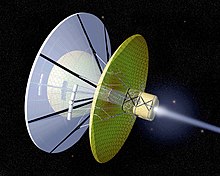
A Bussard ramjet, 1 of many possible methods that could serve to propel spacecraft.
Interstellar travel refers to the idea of interstellar probes or crewed spacecraft moving between stars or planetary systems in a galaxy. Interstellar travel would be much more hard than interplanetary spaceflight. Whereas the distances betwixt the planets in the Solar System are less than xxx astronomical units (AU), the distances between stars are typically hundreds of thousands of AU, and usually expressed in calorie-free-years. Because of the vastness of those distances, non-generational interstellar travel based on known physics would need to occur at a high pct of the speed of light; even so, travel times would exist long, at least decades and peradventure millennia or longer.[one]
As of 2022, five uncrewed spacecraft, all launched and operated by the United States, have achieved the escape velocity required to get out the Solar Arrangement, as part of missions to explore parts of the outer arrangement. They will therefore proceed to travel through interstellar space indefinitely. Still, they will not arroyo another star for hundreds of thousands of years, long after they accept ceased to operate (though in theory the Voyager Golden Record would be playable in the highly unlikely event that the spacecraft is retrieved by an extraterrestrial civilization).
The speeds required for interstellar travel in a homo lifetime far exceed what electric current methods of infinite travel tin provide. Even with a hypothetically perfectly efficient propulsion system, the kinetic energy respective to those speeds is enormous by today's standards of energy development. Moreover, collisions at those speeds, of the spacecraft with cosmic dust and gas, tin can exist very dangerous for both passengers and the spacecraft itself.[1]
A number of strategies take been proposed to bargain with these problems, ranging from giant arks that would carry entire societies and ecosystems, to microscopic space probes. Many different spacecraft propulsion systems have been proposed to give spacecraft the required speeds, including nuclear propulsion, beam-powered propulsion, and methods based on speculative physics.[2]
For both crewed and uncrewed interstellar travel, considerable technological and economic challenges need to be met. Fifty-fifty the well-nigh optimistic views about interstellar travel see it equally simply being feasible in decades. However, in spite of the challenges, if or when interstellar travel is realized, a broad range of scientific benefits are expected.[3]
Most interstellar travel concepts require a developed space logistics system capable of moving millions of tonnes to a construction / operating location, and nearly would require gigawatt-calibration power for construction or ability (such as Star Wisp or Light Canvas type concepts). Such a organization could abound organically if space-based solar ability became a significant component of Earth'southward energy mix. Consumer need for a multi-terawatt system would create the necessary multi-million ton/year logistical organisation.[iv]
Challenges [edit]
Interstellar distances [edit]
Distances between the planets in the Solar System are often measured in astronomical units (AU), defined equally the boilerplate distance betwixt the Sun and Globe, some 1.5×10⁸ kilometers (93 million miles). Venus, the closest planet to Earth is (at closest approach) 0.28 AU abroad. Neptune, the farthest planet from the Sun, is 29.8 AU away. Every bit of January nineteen, 2022, Voyager spaceprobe, the uttermost human being-made object from Earth, is 156 AU away.[5]
The closest known star, Proxima Centauri, is approximately 268,332 AU away, or over 9,000 times farther abroad than Neptune.
| Object | Distance (AU) | Light fourth dimension |
|---|---|---|
| Moon | 0.0026 | 1.three seconds |
| Sun | one | 8 minutes |
| Venus (nearest planet) | 0.28 | 2.41 minutes |
| Neptune (uttermost planet) | 29.8 | 4.1 hours |
| Voyager 1 | 148.7 | twenty.41 hours |
| Proxima Centauri (nearest star and exoplanet) | 268,332 | iv.24 years |
Because of this, distances betwixt stars are usually expressed in light-years (defined as the distance that light travels in vacuum in ane Julian year) or in parsecs (one parsec is 3.26 ly, the altitude at which stellar parallax is exactly one arcsecond, hence the proper noun). Light in a vacuum travels around 300,000 kilometres (186,000 mi) per 2nd, so 1 light-year is about 9.461×ten12 kilometers (five.879 trillion miles) or 63,241 AU. Proxima Centauri, the nearest (admitting not naked-eye visible) star, is 4.243 lite-years away.
Another way of understanding the vastness of interstellar distances is by scaling: I of the closest stars to the Sunday, Alpha Centauri A (a Sunday-like star), can be pictured past scaling down the Earth–Sun distance to 1 meter (three.28 ft). On this scale, the distance to Alpha Centauri A would exist 276 kilometers (171 miles).
The fastest outward-spring spacecraft however sent, Voyager i, has covered i/600 of a light-year in 30 years and is currently moving at 1/18,000 the speed of light. At this rate, a journey to Proxima Centauri would have lxxx,000 years.[six]
Required energy [edit]
A significant factor contributing to the difficulty is the energy that must be supplied to obtain a reasonable travel fourth dimension. A lower bound for the required energy is the kinetic energy where is the final mass. If deceleration on arrival is desired and cannot be accomplished by whatsoever means other than the engines of the transport, and then the lower bound for the required free energy is doubled to .[seven]


The velocity for a crewed circular trip of a few decades to even the nearest star is several thousand times greater than those of present space vehicles. This ways that due to the term in the kinetic energy formula, millions of times as much energy is required. Accelerating 1 ton to 1-10th of the speed of light requires at least 450 petajoules or iv.50×1017 joules or 125 terawatt-hours[8] (world energy consumption 2008 was 143,851 terawatt-hours),[9] without factoring in efficiency of the propulsion mechanism. This energy has to be generated onboard from stored fuel, harvested from the interstellar medium, or projected over immense distances.

Interstellar medium [edit]
A knowledge of the properties of the interstellar gas and dust through which the vehicle must laissez passer is essential for the design of any interstellar space mission.[10] A major result with traveling at extremely loftier speeds is that interstellar dust may crusade considerable damage to the arts and crafts, due to the high relative speeds and large kinetic energies involved. Diverse shielding methods to mitigate this problem have been proposed.[11] Larger objects (such every bit macroscopic grit grains) are far less common, but would be much more than destructive. The risks of impacting such objects, and methods of mitigating these risks, have been discussed in literature, only many unknowns remain[12] and, owing to the inhomogeneous distribution of interstellar matter effectually the Dominicus, will depend on direction travelled.[10] Although a high density interstellar medium may cause difficulties for many interstellar travel concepts, interstellar ramjets, and some proposed concepts for decelerating interstellar spacecraft, would actually benefit from a denser interstellar medium.[ten]
Hazards [edit]
The crew of an interstellar ship would face several pregnant hazards, including the psychological effects of long-term isolation, the effects of exposure to ionizing radiation, and the physiological effects of weightlessness to the muscles, joints, bones, allowed organisation, and eyes. In that location also exists the gamble of touch by micrometeoroids and other space debris. These risks represent challenges that have even so to be overcome.[13]
Wait calculation [edit]
The physicist Robert L. Forward has argued that an interstellar mission that cannot be completed within 50 years should not exist started at all. Instead, bold that a civilisation is still on an increasing curve of propulsion system velocity and non yet having reached the limit, the resources should be invested in designing a ameliorate propulsion system. This is because a irksome spacecraft would probably be passed past another mission sent later with more avant-garde propulsion (the ceaseless obsolescence postulate).[14]
On the other mitt, Andrew Kennedy has shown that if one calculates the journey fourth dimension to a given destination equally the rate of travel speed derived from growth (even exponential growth) increases, there is a clear minimum in the total time to that destination from at present.[xv] Voyages undertaken before the minimum volition be overtaken by those that leave at the minimum, whereas voyages that go out after the minimum volition never overtake those that left at the minimum.
Prime targets for interstellar travel [edit]
There are 59 known stellar systems within 40 light years of the Sun, containing 81 visible stars. The following could be considered prime targets for interstellar missions:[xiv]
| Arrangement | Distance (ly) | Remarks |
|---|---|---|
| Alpha Centauri | 4.iii | Closest system. Three stars (G2, K1, M5). Component A is like to the Lord's day (a G2 star). On August 24, 2016, the discovery of an Earth-size exoplanet (Proxima Centauri b) orbiting in the habitable zone of Proxima Centauri was appear. |
| Barnard's Star | half dozen | Small, depression-luminosity M5 red dwarf. Second closest to Solar Arrangement. |
| Sirius | 8.7 | Large, very brilliant A1 star with a white dwarf companion. |
| Epsilon Eridani | x.eight | Single K2 star slightly smaller and colder than the Sun. Information technology has two asteroid belts, might take a giant and ane much smaller planet,[16] and may possess a Solar-Arrangement-type planetary system. |
| Tau Ceti | 11.8 | Unmarried G8 star similar to the Dominicus. High probability of possessing a Solar-System-blazon planetary organisation: electric current bear witness shows five planets with potentially 2 in the habitable zone. |
| Luyten'southward Star | 12.36 | M3 cerise dwarf with the super-Earth Luyten b orbiting in the habitable zone. |
| Wolf 1061 | ~14 | Wolf 1061 c is four.3 times the size of World; it may have rocky terrain. Information technology as well sits within the 'Goldilocks' zone where information technology might be possible for liquid water to be.[17] |
| Gliese 581 planetary organization | 20.3 | Multiple planet system. The unconfirmed exoplanet Gliese 581g and the confirmed exoplanet Gliese 581d are in the star's habitable zone. |
| Gliese 667C | 22 | A arrangement with at to the lowest degree half-dozen planets. A record-breaking three of these planets are super-Earths lying in the zone around the star where liquid water could exist, making them possible candidates for the presence of life.[18] |
| Vega | 25 | A very young system perchance in the process of planetary formation.[nineteen] |
| TRAPPIST-1 | 39 | A recently discovered system which boasts 7 World-similar planets, some of which may accept liquid water. The discovery is a major advancement in finding a habitable planet and in finding a planet that could support life. |
Existing and most-term astronomical technology is capable of finding planetary systems around these objects, increasing their potential for exploration.
Proposed methods [edit]
Slow, uncrewed probes [edit]
Deadening interstellar missions based on current and well-nigh-futurity propulsion technologies are associated with trip times starting from about ane hundred years to thousands of years. These missions consist of sending a robotic probe to a nearby star for exploration, similar to interplanetary probes like those used in the Voyager program.[20] By taking along no crew, the cost and complexity of the mission is significantly reduced although engineering lifetime is still a significant issue next to obtaining a reasonable speed of travel. Proposed concepts include Projection Daedalus, Projection Icarus, Projection Dragonfly, Project Longshot,[21] and more than recently Quantum Starshot.[22]
Fast, uncrewed probes [edit]
Nanoprobes [edit]
Near-lightspeed nano spacecraft might be possible inside the about hereafter built on existing microchip applied science with a newly developed nanoscale thruster. Researchers at the University of Michigan are developing thrusters that use nanoparticles as propellant. Their technology is chosen "nanoparticle field extraction thruster", or nanoFET. These devices act like small particle accelerators shooting conductive nanoparticles out into space.[23]
Michio Kaku, a theoretical physicist, has suggested that clouds of "smart dust" be sent to the stars, which may get possible with advances in nanotechnology. Kaku besides notes that a large number of nanoprobes would need to be sent due to the vulnerability of very modest probes to be easily deflected past magnetic fields, micrometeorites and other dangers to ensure the chances that at to the lowest degree one nanoprobe will survive the journey and reach the destination.[24]
Every bit a near-term solution, small-scale, laser-propelled interstellar probes, based on electric current CubeSat technology were proposed in the context of Projection Dragonfly.[21]
Wearisome, crewed missions [edit]
In crewed missions, the duration of a irksome interstellar journeying presents a major obstacle and existing concepts deal with this trouble in different means.[25] They can exist distinguished by the "state" in which humans are transported on-lath of the spacecraft.
Generation ships [edit]
A generation ship (or world send) is a type of interstellar ark in which the crew that arrives at the destination is descended from those who started the journey. Generation ships are not currently feasible because of the difficulty of amalgam a transport of the enormous required scale and the great biological and sociological problems that life aboard such a ship raises.[26] [27] [28] [29] [30]
Suspended animation [edit]
Scientists and writers accept postulated various techniques for suspended animation. These include human hibernation and cryonic preservation. Although neither is currently practical, they offer the possibility of sleeper ships in which the passengers lie inert for the long duration of the voyage.[31]
Frozen embryos [edit]
A robotic interstellar mission carrying some number of frozen early phase human embryos is another theoretical possibility. This method of space colonization requires, amongst other things, the evolution of an artificial uterus, the prior detection of a habitable terrestrial planet, and advances in the field of fully democratic mobile robots and educational robots that would replace homo parents.[32]
Isle hopping through interstellar space [edit]
Interstellar space is not completely empty; it contains trillions of icy bodies ranging from small-scale asteroids (Oort cloud) to possible rogue planets. There may be means to take advantage of these resource for a skillful part of an interstellar trip, slowly hopping from body to body or setting upwardly waystations along the fashion.[33]
Fast, crewed missions [edit]
If a spaceship could average 10 percent of light speed (and decelerate at the destination, for human crewed missions), this would be enough to reach Proxima Centauri in forty years. Several propulsion concepts take been proposed[34] that might be somewhen developed to accomplish this (meet § Propulsion below), just none of them are ready for near-term (few decades) developments at acceptable price.
Time dilation [edit]
Physicists generally believe faster-than-light travel is incommunicable. Relativistic fourth dimension dilation allows a traveler to experience time more slowly, the closer their speed is to the speed of light.[35] This apparent slowing becomes noticeable when velocities in a higher place 80% of the speed of light are attained. Clocks aboard an interstellar ship would run slower than Earth clocks, so if a send's engines were capable of continuously generating effectually 1 k of dispatch (which is comfortable for humans), the ship could achieve almost anywhere in the milky way and return to Earth within 40 years ship-time (see diagram). Upon return, at that place would be a deviation between the fourth dimension elapsed on the astronaut's ship and the time elapsed on Earth.
For example, a spaceship could travel to a star 32 lite-years away, initially accelerating at a constant 1.03g (i.e. 10.1 one thousand/stwo) for 1.32 years (ship time), and then stopping its engines and coasting for the side by side 17.3 years (ship time) at a constant speed, then decelerating again for 1.32 send-years, and coming to a stop at the destination. After a brusque visit, the astronaut could return to Earth the same style. After the total circular-trip, the clocks on board the ship show that forty years have passed, but co-ordinate to those on Earth, the send comes dorsum 76 years subsequently launch.
From the viewpoint of the astronaut, onboard clocks seem to be running usually. The star alee seems to be approaching at a speed of 0.87 light years per ship-year. The universe would appear contracted along the direction of travel to half the size it had when the ship was at remainder; the distance between that star and the Sun would seem to exist xvi light years as measured by the astronaut.
At higher speeds, the time on board will run fifty-fifty slower, and so the astronaut could travel to the center of the Milky Way (30,000 calorie-free years from Earth) and back in 40 years ship-time. But the speed according to Earth clocks will e'er exist less than 1 light year per Earth twelvemonth, so, when back home, the astronaut will find that more than 60 m years will have passed on World.
Constant dispatch [edit]
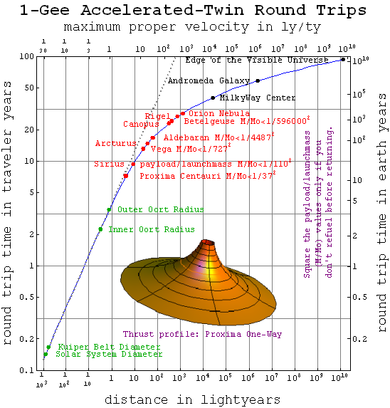
This plot shows a ship capable of 1-m (ten one thousand/due south2 or about ane.0 ly/y2) "felt" or proper-acceleration[36] can go far, except for the problem of accelerating on-board propellant.
Regardless of how it is achieved, a propulsion system that could produce dispatch continuously from departure to inflow would be the fastest method of travel. A constant dispatch journeying is one where the propulsion organisation accelerates the ship at a constant rate for the first half of the journey, then decelerates for the second one-half, then that it arrives at the destination stationary relative to where it began. If this were performed with an acceleration like to that experienced at the Earth's surface, it would accept the added reward of producing bogus "gravity" for the crew. Supplying the free energy required, however, would be prohibitively expensive with current technology.[37]
From the perspective of a planetary observer, the ship will appear to accelerate steadily at first, only then more gradually as information technology approaches the speed of light (which it cannot exceed). It will undergo hyperbolic move.[38] The ship will be shut to the speed of calorie-free after virtually a year of accelerating and remain at that speed until it brakes for the end of the journey.
From the perspective of an onboard observer, the crew volition feel a gravitational field contrary the engine'southward dispatch, and the universe ahead will appear to fall in that field, undergoing hyperbolic motion. As function of this, distances between objects in the direction of the transport's motion will gradually contract until the transport begins to decelerate, at which time an onboard observer'southward experience of the gravitational field will be reversed.
When the ship reaches its destination, if it were to substitution a bulletin with its origin planet, it would observe that less time had elapsed on lath than had elapsed for the planetary observer, due to time dilation and length contraction.
The consequence is an impressively fast journey for the crew.
Propulsion [edit]
Rocket concepts [edit]
All rocket concepts are limited by the rocket equation, which sets the feature velocity available as a function of frazzle velocity and mass ratio, the ratio of initial (G 0, including fuel) to final (M i, fuel depleted) mass.
Very loftier specific ability, the ratio of thrust to total vehicle mass, is required to attain interstellar targets within sub-century fourth dimension-frames.[39] Some heat transfer is inevitable and a tremendous heating load must be adequately handled.
Thus, for interstellar rocket concepts of all technologies, a cardinal technology problem (seldom explicitly discussed) is limiting the oestrus transfer from the frazzle stream back into the vehicle.[forty]
Ion engine [edit]
A blazon of electric propulsion, spacecraft such as Dawn apply an ion engine. In an ion engine, electric ability is used to create charged particles of the propellant, commonly the gas xenon, and accelerate them to extremely high velocities. The exhaust velocity of conventional rockets is express to about 5 km/s by the chemic energy stored in the fuel's molecular bonds. They produce a high thrust (about 10six N), simply they have a low specific impulse, and that limits their top speed. By contrast, ion engines have low force, but the top speed in principle is express but by the electrical power available on the spacecraft and on the gas ions being accelerated. The exhaust speed of the charged particles range from 15 km/s to 35 km/s.[41]
Nuclear fission powered [edit]
Fission-electric [edit]
Nuclear-electric or plasma engines, operating for long periods at depression thrust and powered by fission reactors, take the potential to reach speeds much greater than chemically powered vehicles or nuclear-thermal rockets. Such vehicles probably take the potential to power solar organization exploration with reasonable trip times within the current century. Because of their low-thrust propulsion, they would be limited to off-planet, deep-space performance. Electrically powered spacecraft propulsion powered by a portable ability-source, say a nuclear reactor, producing merely small-scale accelerations, would take centuries to reach for instance 15% of the velocity of calorie-free, thus unsuitable for interstellar flight during a unmarried human being lifetime.[42]
Fission-fragment [edit]
Fission-fragment rockets use nuclear fission to create high-speed jets of fission fragments, which are ejected at speeds of up to 12,000 km/s (seven,500 mi/s). With fission, the energy output is approximately 0.1% of the total mass-energy of the reactor fuel and limits the effective exhaust velocity to about five% of the velocity of low-cal. For maximum velocity, the reaction mass should optimally consist of fission products, the "ash" of the primary energy source, and then no extra reaction mass need be bookkept in the mass ratio.
Nuclear pulse [edit]
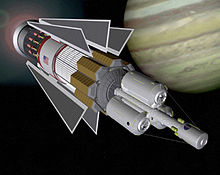
Modernistic Pulsed Fission Propulsion Concept.
Based on work in the late 1950s to the early 1960s, it has been technically possible to build spaceships with nuclear pulse propulsion engines, i.e. driven by a serial of nuclear explosions. This propulsion organisation contains the prospect of very high specific impulse (space travel's equivalent of fuel economy) and high specific power.[43]
Project Orion squad fellow member Freeman Dyson proposed in 1968 an interstellar spacecraft using nuclear pulse propulsion that used pure deuterium fusion detonations with a very high fuel-burnup fraction. He computed an exhaust velocity of 15,000 km/due south and a 100,000-tonne infinite vehicle able to achieve a twenty,000 km/due south delta-v allowing a flight-time to Alpha Centauri of 130 years.[44] Subsequently studies indicate that the meridian prowl velocity that can theoretically exist achieved by a Teller-Ulam thermonuclear unit powered Orion starship, bold no fuel is saved for slowing back down, is about viii% to x% of the speed of light (0.08-0.1c).[45] An atomic (fission) Orion can reach perhaps three%-five% of the speed of low-cal. A nuclear pulse drive starship powered by fusion-antimatter catalyzed nuclear pulse propulsion units would be similarly in the 10% range and pure thing-antimatter annihilation rockets would be theoretically capable of obtaining a velocity between 50% to lxxx% of the speed of low-cal. In each case saving fuel for slowing downwards halves the maximum speed. The concept of using a magnetic sheet to decelerate the spacecraft as it approaches its destination has been discussed as an alternative to using propellant, this would allow the ship to travel near the maximum theoretical velocity.[46] Culling designs utilizing similar principles include Project Longshot, Projection Daedalus, and Mini-Mag Orion. The principle of external nuclear pulse propulsion to maximize survivable power has remained common among serious concepts for interstellar flight without external power beaming and for very loftier-operation interplanetary flight.
In the 1970s the Nuclear Pulse Propulsion concept further was refined by Projection Daedalus past employ of externally triggered inertial confinement fusion, in this case producing fusion explosions via compressing fusion fuel pellets with high-powered electron beams. Since then, lasers, ion beams, neutral particle beams and hyper-kinetic projectiles have been suggested to produce nuclear pulses for propulsion purposes.[47]
A current impediment to the development of any nuclear-explosion-powered spacecraft is the 1963 Partial Test Ban Treaty, which includes a prohibition on the detonation of any nuclear devices (fifty-fifty non-weapon based) in outer infinite. This treaty would, therefore, need to be renegotiated, although a project on the scale of an interstellar mission using currently foreseeable technology would probably crave international cooperation on at least the scale of the International Space Station.
Another issue to be considered, would exist the k-forces imparted to a rapidly accelerated spacecraft, cargo, and passengers inside (see Inertia negation).
Nuclear fusion rockets [edit]
Fusion rocket starships, powered past nuclear fusion reactions, should feasibly be able to reach speeds of the guild of x% of that of light, based on free energy considerations alone. In theory, a large number of stages could push a vehicle arbitrarily close to the speed of light.[48] These would "burn" such low-cal element fuels equally deuterium, tritium, 3He, xiB, and 7Li. Because fusion yields about 0.3–0.9% of the mass of the nuclear fuel every bit released energy, it is energetically more favorable than fission, which releases <0.1% of the fuel's mass-free energy. The maximum exhaust velocities potentially energetically bachelor are correspondingly higher than for fission, typically iv–x% of the speed of calorie-free. However, the most easily doable fusion reactions release a large fraction of their energy as high-energy neutrons, which are a significant source of energy loss. Thus, although these concepts seem to offer the best (nearest-term) prospects for travel to the nearest stars within a (long) human lifetime, they however involve massive technological and technology difficulties, which may turn out to be intractable for decades or centuries.
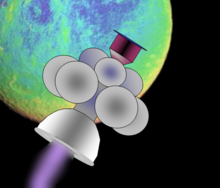
Daedalus interstellar probe.
Early studies include Project Daedalus, performed by the British Interplanetary Club in 1973–1978, and Project Longshot, a pupil project sponsored by NASA and the United states Naval Academy, completed in 1988. Some other fairly detailed vehicle system, "Discovery II",[49] designed and optimized for crewed Solar System exploration, based on the D3He reaction but using hydrogen as reaction mass, has been described past a team from NASA's Glenn Inquiry Center. Information technology achieves characteristic velocities of >300 km/s with an acceleration of ~1.vii•ten−3 k, with a ship initial mass of ~1700 metric tons, and payload fraction above 10%. Although these are still far short of the requirements for interstellar travel on human timescales, the written report seems to represent a reasonable benchmark towards what may be outgoing inside several decades, which is not impossibly beyond the current country-of-the-art. Based on the concept's two.2% burnup fraction information technology could reach a pure fusion product exhaust velocity of ~three,000 km/south.
Antimatter rockets [edit]
An antimatter rocket would have a far higher energy density and specific impulse than whatever other proposed class of rocket.[34] If energy resources and efficient production methods are found to make antimatter in the quantities required and shop[50] [51] it safely, it would exist theoretically possible to accomplish speeds of several tens of percent that of calorie-free.[34] Whether antimatter propulsion could lead to the higher speeds (>ninety% that of light) at which relativistic time dilation would become more than noticeable, thus making time pass at a slower rate for the travelers as perceived by an outside observer, is doubtful owing to the large quantity of antimatter that would be required.[34] [52]
Speculating that product and storage of antimatter should go feasible, two further problems need to be considered. Outset, in the annihilation of antimatter, much of the energy is lost as loftier-energy gamma radiation, and peculiarly also as neutrinos, so that just about 40% of mc 2 would actually be available if the antimatter were simply immune to annihilate into radiation thermally.[34] Withal, the energy available for propulsion would be substantially college than the ~1% of mc 2 yield of nuclear fusion, the adjacent-all-time rival candidate.
Second, heat transfer from the exhaust to the vehicle seems likely to transfer enormous wasted free energy into the ship (due east.g. for 0.oneg ship acceleration, approaching 0.3 trillion watts per ton of ship mass), considering the large fraction of the energy that goes into penetrating gamma rays. Even assuming shielding was provided to protect the payload (and passengers on a crewed vehicle), some of the free energy would inevitably heat the vehicle, and may thereby prove a limiting factor if useful accelerations are to be accomplished.
More recently, Friedwardt Winterberg proposed that a thing-antimatter GeV gamma ray light amplification by stimulated emission of radiation photon rocket is possible past a relativistic proton-antiproton pinch discharge, where the recoil from the light amplification by stimulated emission of radiation beam is transmitted past the Mössbauer effect to the spacecraft.[53]
Rockets with an external free energy source [edit]
Rockets deriving their power from external sources, such equally a laser, could replace their internal energy source with an energy collector, potentially reducing the mass of the ship greatly and allowing much higher travel speeds. Geoffrey A. Landis has proposed an interstellar probe, with free energy supplied by an external laser from a base station powering an Ion thruster.[54]
Not-rocket concepts [edit]
A trouble with all traditional rocket propulsion methods is that the spacecraft would need to behave its fuel with it, thus making it very massive, in accordance with the rocket equation. Several concepts endeavor to escape from this problem:[34] [55]
RF resonant cavity thruster [edit]
A radio frequency (RF) resonant cavity thruster is a device that is claimed to be a spacecraft thruster. In 2016, the Avant-garde Propulsion Physics Laboratory at NASA reported observing a small-scale apparent thrust from 1 such test, a result not since replicated.[56] One of the designs is called EMDrive. In December 2002, Satellite Propulsion Enquiry Ltd described a working paradigm with an declared total thrust of almost 0.02 newtons powered by an 850 W cavity magnetron. The device could operate for just a few dozen seconds before the magnetron failed, due to overheating.[57] The latest test on the EMDrive concluded that it does not piece of work.[58]
Helical engine [edit]
Proposed in 2019 by NASA scientist Dr. David Burns, the helical engine concept would use a particle accelerator to advance particles to virtually the speed of light. Since particles traveling at such speeds acquire more mass, it is believed that this mass change could create acceleration. According to Burns, the spacecraft could theoretically reach 99% the speed of calorie-free.[59]
Interstellar ramjets [edit]
In 1960, Robert W. Bussard proposed the Bussard ramjet, a fusion rocket in which a huge scoop would collect the diffuse hydrogen in interstellar space, "burn" information technology on the fly using a proton–proton chain reaction, and miscarry it out of the back. Later on calculations with more than accurate estimates suggest that the thrust generated would be less than the elevate acquired past any believable scoop design.[ citation needed ] Yet the thought is bonny considering the fuel would be collected en road (commensurate with the concept of energy harvesting), and so the craft could theoretically accelerate to about the speed of light. The limitation is due to the fact that the reaction tin only advance the propellant to 0.12c. Thus the drag of catching interstellar dust and the thrust of accelerating that same dust to 0.12c would be the same when the speed is 0.12c, preventing further dispatch.
Beamed propulsion [edit]
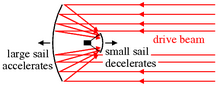
A calorie-free sail or magnetic sheet powered by a massive laser or particle accelerator in the dwelling house star organisation could potentially reach even greater speeds than rocket- or pulse propulsion methods, because it would not need to carry its own reaction mass and therefore would just need to accelerate the arts and crafts's payload. Robert L. Forward proposed a means for decelerating an interstellar craft with a low-cal sail of 100 kilometers in the destination star system without requiring a laser assortment to be present in that system. In this scheme, a secondary sail of 30 kilometers is deployed to the rear of the spacecraft, while the large primary sail is discrete from the craft to keep moving forward on its own. Low-cal is reflected from the large chief sail to the secondary sheet, which is used to decelerate the secondary canvass and the spacecraft payload.[60] In 2002, Geoffrey A. Landis of NASA's Glen Inquiry center as well proposed a laser-powered, propulsion, sail ship that would host a diamond sail (of a few nanometers thick) powered with the apply of solar energy.[61] With this proposal, this interstellar ship would, theoretically, exist able to achieve 10 percent the speed of lite. It has also been proposed to use beamed-powered propulsion to accelerate a spacecraft, and electromagnetic propulsion to decelerate it; thus, eliminating the problem that the Bussard ramjet has with the drag produced during acceleration.[62]
A magnetic sail could also decelerate at its destination without depending on carried fuel or a driving beam in the destination system, past interacting with the plasma plant in the solar wind of the destination star and the interstellar medium.[63] [64]
The post-obit table lists some example concepts using beamed laser propulsion as proposed past the physicist Robert L. Frontwards:[65]
| Mission | Laser Power | Vehicle Mass | Acceleration | Sail Diameter | Maximum Velocity (% of the speed of light) |
|---|---|---|---|---|---|
| i. Flyby – Alpha Centauri, xl years | |||||
| outbound stage | 65 GW | 1 t | 0.036 one thousand | 3.6 km | 11% @ 0.17 ly |
| 2. Rendezvous – Blastoff Centauri, 41 years | |||||
| outbound phase | seven,200 GW | 785 t | 0.005 m | 100 km | 21% @ iv.29 ly[ dubious ] |
| deceleration stage | 26,000 GW | 71 t | 0.2 g | 30 km | 21% @ 4.29 ly |
| 3. Crewed – Epsilon Eridani, 51 years (including v years exploring star system) | |||||
| outbound stage | 75,000,000 GW | 78,500 t | 0.iii one thousand | yard km | l% @ 0.four ly |
| deceleration phase | 21,500,000 GW | 7,850 t | 0.three thousand | 320 km | 50% @ 10.4 ly |
| render stage | 710,000 GW | 785 t | 0.iii thousand | 100 km | 50% @ 10.four ly |
| deceleration stage | threescore,000 GW | 785 t | 0.3 g | 100 km | 50% @ 0.4 ly |
Interstellar travel itemize to use photogravitational assists for a full terminate [edit]
The following table is based on work past Heller, Hippke and Kervella.[66]
| Proper noun | Travel time (yr) | Distance (ly) | Luminosity (L☉) |
|---|---|---|---|
| Sirius A | 68.ninety | 8.58 | 24.20 |
| α Centauri A | 101.25 | iv.36 | 1.52 |
| α Centauri B | 147.58 | 4.36 | 0.fifty |
| Procyon A | 154.06 | 11.44 | 6.94 |
| Vega | 167.39 | 25.02 | 50.05 |
| Altair | 176.67 | 16.69 | ten.70 |
| Fomalhaut A | 221.33 | 25.13 | sixteen.67 |
| Denebola | 325.56 | 35.78 | xiv.66 |
| Castor A | 341.35 | l.98 | 49.85 |
| Epsilon Eridani | 363.35 | 10.50 | 0.50 |
- Successive assists at α Cen A and B could allow travel times to 75 yr to both stars.
- Lightsail has a nominal mass-to-surface ratio (σnom) of 8.six×x−four gram m−2 for a nominal graphene-course sail.
- Area of the Lightsail, near 105 mtwo = (316 m)two
- Velocity upward to 37,300 km southward−one (12.5% c)
Pre-accelerated fuel [edit]
Achieving commencement-stop interstellar trip times of less than a human lifetime crave mass-ratios of between 1,000 and 1,000,000, even for the nearer stars. This could be achieved by multi-staged vehicles on a vast scale.[48] Alternatively big linear accelerators could propel fuel to fission propelled space-vehicles, avoiding the limitations of the Rocket equation.[67]
Theoretical concepts [edit]
Manual of minds with calorie-free [edit]
Uploaded human minds or AI could exist transmitted with laser or radio signals at the speed of light.[68] This requires a receiver at the destination which would first accept to be gear up up eastward.g. by humans, probes, self replicating machines (potentially forth with AI or uploaded humans), or an alien civilization (which might as well exist in a different milky way, perhaps a Kardashev type 3 civilization).
Faster-than-low-cal travel [edit]
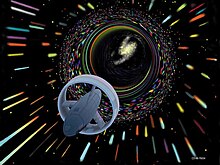
Scientists and authors have postulated a number of ways past which it might exist possible to surpass the speed of lite, but even the nearly serious-minded of these are highly speculative.[69]
It is also debatable whether faster-than-calorie-free travel is physically possible, in function because of causality concerns: travel faster than low-cal may, under sure conditions, permit travel backwards in fourth dimension inside the context of special relativity.[70] Proposed mechanisms for faster-than-light travel within the theory of general relativity crave the existence of exotic matter[69] and it is not known if this could be produced in sufficient quantity.
Alcubierre bulldoze [edit]
In physics, the Alcubierre bulldoze is based on an argument, within the framework of general relativity and without the introduction of wormholes, that it is possible to modify spacetime in a way that allows a spaceship to travel with an arbitrarily large speed by a local expansion of spacetime behind the spaceship and an opposite contraction in front end of it.[71] Nevertheless, this concept would require the spaceship to comprise a region of exotic matter, or hypothetical concept of negative mass.[71]
Bogus black hole [edit]
A theoretical thought for enabling interstellar travel is by propelling a starship past creating an bogus black hole and using a parabolic reflector to reflect its Hawking radiation. Although beyond current technological capabilities, a blackness hole starship offers some advantages compared to other possible methods. Getting the blackness hole to human activity as a power source and engine too requires a mode to catechumen the Hawking radiations into energy and thrust. One potential method involves placing the hole at the focal point of a parabolic reflector fastened to the transport, creating forward thrust. A slightly easier, but less efficient method would involve simply absorbing all the gamma radiation heading towards the fore of the send to push button information technology onwards, and let the rest shoot out the back.[72] [73] [74]
Wormholes [edit]
Wormholes are conjectural distortions in spacetime that theorists postulate could connect two arbitrary points in the universe, across an Einstein–Rosen Span. It is not known whether wormholes are possible in practise. Although there are solutions to the Einstein equation of full general relativity that allow for wormholes, all of the currently known solutions involve some assumption, for instance the existence of negative mass, which may be unphysical.[75] Nonetheless, Cramer et al. fence that such wormholes might accept been created in the early universe, stabilized by catholic strings.[76] The general theory of wormholes is discussed by Visser in the book Lorentzian Wormholes.[77]
Designs and studies [edit]
Enzmann starship [edit]
The Enzmann starship, as detailed past 1000. Harry Stine in the October 1973 event of Analog, was a design for a future starship, based on the ideas of Robert Duncan-Enzmann. The spacecraft itself as proposed used a 12,000,000 ton brawl of frozen deuterium to power 12–24 thermonuclear pulse propulsion units. Twice equally long as the Empire Land Building and assembled in-orbit, the spacecraft was part of a larger project preceded by interstellar probes and telescopic observation of target star systems.[78]
Project Hyperion [edit]
Projection Hyperion, i of the projects of Icarus Interstellar has looked into various feasibility bug of crewed interstellar travel.[79] [eighty] [81] Its members go on to publish on crewed interstellar travel in collaboration with the Initiative for Interstellar Studies.[27]
NASA research [edit]
NASA has been researching interstellar travel since its germination, translating important foreign language papers and conducting early studies on applying fusion propulsion, in the 1960s, and laser propulsion, in the 1970s, to interstellar travel.
In 1994, NASA and JPL cosponsored a "Workshop on Advanced Quantum/Relativity Theory Propulsion" to "establish and use new frames of reference for thinking well-nigh the faster-than-light (FTL) question".[82]
The NASA Quantum Propulsion Physics Program (terminated in FY 2003 after a six-year, $1.ii-meg study, because "No breakthroughs appear imminent.")[83] identified some breakthroughs that are needed for interstellar travel to be possible.[84]
Geoffrey A. Landis of NASA's Glenn Research Center states that a laser-powered interstellar canvass ship could possibly be launched within 50 years, using new methods of space travel. "I think that ultimately we're going to do it, information technology's just a question of when and who," Landis said in an interview. Rockets are too wearisome to send humans on interstellar missions. Instead, he envisions interstellar craft with extensive sails, propelled by light amplification by stimulated emission of radiation light to about ane-10th the speed of calorie-free. It would take such a ship about 43 years to reach Alpha Centauri if information technology passed through the system without stopping. Slowing down to end at Alpha Centauri could increment the trip to 100 years,[85] whereas a journey without slowing downward raises the result of making sufficiently accurate and useful observations and measurements during a fly-by.
100 Twelvemonth Starship study [edit]
The 100 Year Starship (100YSS) report was the name of a one-yr project to appraise the attributes of and lay the groundwork for an organization that can comport forward the 100 Year Starship vision. 100YSS-related symposia were organized between 2011 and 2015.
Harold ("Sonny") White[86] from NASA's Johnson Space Eye is a member of Icarus Interstellar,[87] the nonprofit foundation whose mission is to realize interstellar flight before the twelvemonth 2100. At the 2012 coming together of 100YSS, he reported using a laser to try to warp spacetime by 1 function in ten million with the aim of helping to brand interstellar travel possible.[88]
Other designs [edit]
- Project Orion, human crewed interstellar send (1958–1968).
- Project Daedalus, uncrewed interstellar probe (1973–1978).
- Starwisp, uncrewed interstellar probe (1985).[89]
- Project Longshot, uncrewed interstellar probe (1987–1988).
- Starseed/launcher, fleet of uncrewed interstellar probes (1996)
- Projection Valkyrie, human crewed interstellar ship (2009)
- Project Icarus, uncrewed interstellar probe (2009–2014).
- Sunday-diver, uncrewed interstellar probe[xc]
- Project Dragonfly, small laser-propelled interstellar probe (2013-2015).
- Breakthrough Starshot, armada of uncrewed interstellar probes, announced on April 12, 2016.[91] [92] [93]
Non-profit organizations [edit]
A few organisations dedicated to interstellar propulsion enquiry and advancement for the case be worldwide. These are still in their infancy, only are already backed up by a membership of a wide variety of scientists, students and professionals.
- Initiative for Interstellar Studies (United kingdom of great britain and northern ireland)[94]
- Tau Zero Foundation (USA)[95]
Feasibility [edit]
The free energy requirements make interstellar travel very hard. It has been reported that at the 2008 Joint Propulsion Conference, multiple experts opined that it was improbable that humans would always explore beyond the Solar System.[96] Brice Northward. Cassenti, an associate professor with the Department of Engineering and Science at Rensselaer Polytechnic Institute, stated that at least 100 times the full energy output of the entire world [in a given yr] would exist required to transport a probe to the nearest star.[96]
Astrophysicist Sten Odenwald stated that the basic problem is that through intensive studies of thousands of detected exoplanets, most of the closest destinations within 50 light years exercise non yield Earth-like planets in the star's habitable zones.[97] Given the multitrillion-dollar expense of some of the proposed technologies, travelers will take to spend up to 200 years traveling at 20% the speed of lite to reach the best known destinations. Moreover, one time the travelers arrive at their destination (by whatsoever means), they volition not be able to travel down to the surface of the target world and fix a colony unless the atmosphere is non-lethal. The prospect of making such a journey, only to spend the residual of the colony's life within a sealed habitat and venturing exterior in a spacesuit, may eliminate many prospective targets from the list.
Moving at a speed close to the speed of lite and encountering even a tiny stationary object similar a grain of sand will have fatal consequences. For instance, a gram of affair moving at 90% of the speed of light contains a kinetic energy corresponding to a small nuclear bomb (around 30kt TNT).
I of the major stumbling blocks is having enough Onboard Spares & Repairs facilities for such a lengthy time journey assuming all other considerations are solved, without access to all the resource available on Earth.[98]
Interstellar missions not for human benefit [edit]
Explorative high-speed missions to Alpha Centauri, every bit planned for by the Breakthrough Starshot initiative, are projected to be realizable within the 21st century.[99] It is alternatively possible to plan for uncrewed slow-cruising missions taking millennia to arrive. These probes would not be for human being do good in the sense that one tin can not foresee whether there would exist anybody around on earth interested in and so back-transmitted science data. An example would be the Genesis mission,[100] which aims to bring unicellular life, in the spirit of directed panspermia, to habitable simply otherwise barren planets.[101] Comparatively irksome cruising Genesis probes, with a typical speed of , corresponding to virtually , can exist decelerated using a magnetic sail. Uncrewed missions not for human being benefit would hence be feasible.[102] For biotic ethics, and their extension to space every bit panbiotic ideals, it is a human purpose to secure and propagate life and to apply infinite to maximize life.


Discovery of Earth-Similar planets [edit]
In Feb 2017, NASA announced that its Spitzer Space Telescope had revealed seven Globe-size planets in the TRAPPIST-1 system orbiting an ultra-cool dwarf star twoscore light-years away from the Solar System.[103] Three of these planets are firmly located in the habitable zone, the area around the parent star where a rocky planet is well-nigh likely to accept liquid water. The discovery sets a new record for greatest number of habitable-zone planets plant around a single star outside the Solar System. All of these vii planets could have liquid water – the key to life as we know it – under the right atmospheric conditions, only the chances are highest with the three in the habitable zone.
See also [edit]
- Outcome of spaceflight on the human body – Medical consequences of spaceflight
- Health threat from cosmic rays
- Human spaceflight – Space travel by humans
- Intergalactic travel – Hypothetical travel between galaxies
- Interstellar communication – Communication between planetary systems
- Interstellar object
- List of nearest terrestrial exoplanet candidates
- Spacecraft propulsion – Method used to accelerate spacecraft
- Space travel in science fiction
- Uploaded astronaut
References [edit]
- ^ a b Mauldin, John H. (May 1992). Prospects for interstellar travel . Published for the American Astronautical Club by Univelt.
Interstellar travel.
- ^ "Interstellar Travel". www.bis-infinite.com. Archived from the original on 2017-06-16. Retrieved 2017-06-16 .
- ^ Crawford, I. A. (2009). "The Astronomical, Astrobiological and Planetary Scientific discipline Case for Interstellar Spaceflight". Journal of the British Interplanetary Society. 62: 415–421. arXiv:1008.4893. Bibcode:2009JBIS...62..415C.
- ^ Decision of the 2016 Tennessee Valley Interstellar Workshop Space Solar Ability Working Track run by Peter Garretson & Robert Kennedy.
- ^ Elizabeth Howell (January 19, 2022). "Voyager ane: Earth's farthest spacecraft". Space.com . Retrieved 8 April 2022.
- ^ "A Look at the Scaling". nasa.gov. NASA Glenn Research Center. 2015-03-11.
- ^ Millis, Marc G. (2011). "Energy, incessant obsolescence, and the first interstellar missions". arXiv:1101.1066.
- ^ Zirnstein, E.J (2013). "Simulating the Compton-Getting Consequence for Hydrogen Flux Measurements: Implications for IBEX-Hi and -Lo Observations". Astrophysical Periodical. 778 (2): 112–127. Bibcode:2013ApJ...778..112Z. doi:10.1088/0004-637x/778/2/112.
- ^ Outer Solar System : prospective free energy and material resources. Badescu, Viorel,, Zacny, Kris. Cham, Switzerland. 2018-04-28. ISBN9783319738451. OCLC 1033673323.
{{cite book}}: CS1 maint: others (link) - ^ a b c Crawford, I. A. (2011). "Project Icarus: A review of local interstellar medium properties of relevance for space missions to the nearest stars". Acta Astronautica. 68 (seven–eight): 691–699. arXiv:1010.4823. Bibcode:2011AcAau..68..691C. doi:x.1016/j.actaastro.2010.x.016. S2CID 101553.
- ^ Westover, Shayne (27 March 2012). Active Radiation Shielding Utilizing High Temperature Superconductors (PDF). NIAC Symposium.
- ^ Garrett, Henry (xxx July 2012). "There and Back Again: A Layman's Guide to Ultra-Reliability for Interstellar Missions" (PDF). Archived from the original (PDF) on eight May 2014.
- ^ Gibson, Dirk C. (2015). Terrestrial and Extraterrestrial Space Dangers: Outer Infinite Perils, Rocket Risks and the Health Consequences of the Space Environment. Bentham Science Publishers. p. i. ISBN978-ane-60805-991-1.
- ^ a b Forward, Robert 50. (1996). "Ad Astra!". Journal of the British Interplanetary Order. 49 (ane): 23–32. Bibcode:1996JBIS...49...23F.
- ^ Kennedy, Andrew (July 2006). "Interstellar Travel: The Expect Calculation and the Incentive Trap of Progress". Journal of the British Interplanetary Society. 59 (7): 239–246. Bibcode:2006JBIS...59..239K.
- ^ "Planet eps Eridani b". exoplanet.eu . Retrieved 2011-01-15 .
- ^ Astronomers Have Discovered The Closest Potentially Habitable Planet. Yahoo News. December 18, 2015.
- ^ "Three Planets in Habitable Zone of Nearby Star". eso.org.
- ^ Croswell, Ken (3 December 2012). "ScienceShot: Older Vega Mature Enough to Nurture Life". sciencemag.org. Archived from the original on four December 2012.
- ^ Voyager. Louisiana State University: ERIC Clearing Firm. 1977. p. 12. Retrieved 2015-10-26 .
- ^ a b "Project Dragonfly: The case for small, light amplification by stimulated emission of radiation-propelled, distributed probes". Centauri Dreams . Retrieved 12 June 2015.
- ^ Nogrady, Bianca. "The myths and reality nigh interstellar travel". Retrieved 2017-06-16 .
- ^ Daniel H. Wilson. Near-lightspeed nano spacecraft might be close. msnbc.msn.com.
- ^ Kaku, Michio. The Physics of the Incommunicable. Anchor Books.
- ^ Hein, A. M. "How Will Humans Fly to the Stars?". Retrieved 12 April 2013.
- ^ Hein, A. M.; et al. (2012). "World Ships: Architectures & Feasibility Revisited". Journal of the British Interplanetary Society. 65: 119–133. Bibcode:2012JBIS...65..119H.
- ^ a b Hein, A.M.; Smith, C.; Marin, F.; Staats, Thousand. (2020). "World Ships: Feasibility and Rationale". Acta Futura. 12: 75–104. arXiv:2005.04100. doi:10.5281/zenodo.3747333. S2CID 218571111.
- ^ Bond, A.; Martin, A.R. (1984). "World Ships – An Cess of the Engineering science Feasibility". Periodical of the British Interplanetary Guild. 37: 254–266. Bibcode:1984JBIS...37..254B.
- ^ Frisbee, R.H. (2009). Limits of Interstellar Flight Engineering in Frontiers of Propulsion Science. Progress in Astronautics and Helmsmanship.
- ^ Hein, Andreas Thou. "Project Hyperion: The Hollow Asteroid Starship – Broadcasting of an Idea". Archived from the original on 10 April 2013. Retrieved 12 April 2013.
- ^ "Diverse articles on hibernation". Journal of the British Interplanetary Society. 59: 81–144. 2006.
- ^ Crowl, A.; Hunt, J.; Hein, A.M. (2012). "Embryo Infinite Colonisation to Overcome the Interstellar Time Distance Bottleneck". Journal of the British Interplanetary Society. 65: 283–285. Bibcode:2012JBIS...65..283C.
- ^ "'Island-Hopping' to the Stars". Centauri Dreams . Retrieved 12 June 2015.
- ^ a b c d e f Crawford, I. A. (1990). "Interstellar Travel: A Review for Astronomers". Quarterly Journal of the Royal Astronomical Lodge. 31: 377–400. Bibcode:1990QJRAS..31..377C.
- ^ Parkinson, Bradford W.; Spilker, James J. Jr.; Axelrad, Penina; Enge, Per (2014). xviii.2.2.1Time Dilation. American Found of Aeronautics and Astronautics. ISBN978-1-56347-106-3 . Retrieved 27 Oct 2015.
- ^ "Clock paradox III" (PDF). Archived from the original (PDF) on 2017-07-21. Retrieved 2014-08-31 . Taylor, Edwin F.; Wheeler, John Archibald (1966). "Affiliate 1 Exercise 51". Spacetime Physics. Due west.H. Freeman, San Francisco. pp. 97–98. ISBN978-0-7167-0336-5.
- ^ Crowell, Benjamin (2011), Low-cal and Matter Section four.3
- ^ Yagasaki, Kazuyuki (2008). "Invariant Manifolds And Control Of Hyperbolic Trajectories On Infinite- Or Finite-Time Intervals". Dynamical Systems. 23 (3): 309–331. doi:x.1080/14689360802263571. S2CID 123409581.
- ^ Orth, C. D. (16 May 2003). "VISTA – A Vehicle for Interplanetary Space Transport Application Powered past Inertial Confinement Fusion" (PDF). Lawrence Livermore National Laboratory.
- ^ Clarke, Arthur C. (1951). The Exploration of Space . New York: Harper.
- ^ Dawn Of A New Era: The Revolutionary Ion Engine That Took Spacecraft To Ceres
- ^ Project Daedalus: The Propulsion System Part 1; Theoretical considerations and calculations. 2. REVIEW OF ADVANCED PROPULSION SYSTEMS, archived from the original on 2013-06-28
- ^ Full general Dynamics Corp. (January 1964). "Nuclear Pulse Vehicle Study Condensed Summary Report (General Dynamics Corp.)" (PDF). U.S. Department of Commerce National Technical Information Service.
- ^ Freeman J. Dyson (October 1968). "Interstellar Transport". Physics Today. 21 (10): 41. Bibcode:1968PhT....21j..41D. doi:x.1063/i.3034534.
- ^ Cosmos by Carl Sagan
- ^ Lenard, Roger X.; Andrews, Dana G. (June 2007). "Use of Mini-Mag Orion and superconducting coils for near-term interstellar transportation" (PDF). Acta Astronautica. 61 (i–six): 450–458. Bibcode:2007AcAau..61..450L. doi:10.1016/j.actaastro.2007.01.052. Archived from the original (PDF) on 2014-06-17. Retrieved 2013-xi-24 .
- ^ Friedwardt Winterberg (2010). The Release of Thermonuclear Free energy by Inertial Confinement. World Scientific. ISBN978-981-4295-91-viii.
- ^ a b D.F. Spencer; L.D. Jaffe (1963). "Feasibility of Interstellar Travel". Astronautica Acta. ix: 49–58.
- ^ PDF C. R. Williams et al., 'Realizing "2001: A Infinite Odyssey": Piloted Spherical Torus Nuclear Fusion Propulsion', 2001, 52 pages, NASA Glenn Research Center
- ^ "Storing antimatter - CERN". habitation.web.cern.ch.
- ^ "Alpha Stores Antimatter Atoms Over a Quarter of an Hour – and Still Counting - Berkeley Lab". five June 2011.
- ^ Rouaud, Mathieu (2020). Interstellar travel and antimatter (PDF). ISBN9782954930930.
- ^ Winterberg, F. (21 August 2012). "Affair–antimatter gigaelectron volt gamma ray light amplification by stimulated emission of radiation rocket propulsion". Acta Astronautica. 81 (i): 34–39. Bibcode:2012AcAau..81...34W. doi:10.1016/j.actaastro.2012.07.001.
- ^ Landis, Geoffrey A. (29 August 1994). Light amplification by stimulated emission of radiation-powered Interstellar Probe. Conference on Practical Robotic Interstellar Flight. NY University, New York, NY. Archived from the original on 2 Oct 2013.
- ^ A. Bolonkin (2005). Non Rocket Space Launch and Flight. Elsevier. ISBN 978-0-08-044731-five
- ^ "NASA Team Claims 'Impossible' Space Engine Works—Go the Facts". National Geographic News. 2016-11-21. Retrieved 2019-xi-12 .
- ^ "Roger SHAWYER -- EM Infinite Drive -- Articles & Patent". rexresearch.com . Retrieved 2019-eleven-12 .
- ^ McRae, Mike. "The Latest Examination on The 'Incommunicable' EM Drive Concludes It Doesn't Work". ScienceAlert . Retrieved 2019-11-12 .
- ^ Starr, Michelle. "NASA Engineer Claims 'Helical Engine' Concept Could Attain 99% The Speed of Light Without Propellant". ScienceAlert . Retrieved 2019-11-12 .
- ^ Frontward, R.L. (1984). "Roundtrip Interstellar Travel Using Laser-Pushed Lightsails". J Spacecraft. 21 (2): 187–195. Bibcode:1984JSpRo..21..187F. doi:10.2514/3.8632.
- ^ "Alpha Centauri: Our Commencement Target for Interstellar Probes" – via go.galegroup.com.
- ^ Delbert, Caroline (2020-12-09). "The Radical Spacecraft That Could Send Humans to a Habitable Exoplanet". Pop Mechanics . Retrieved 2020-12-12 .
- ^ Andrews, Dana Chiliad.; Zubrin, Robert One thousand. (1990). "Magnetic Sails and Interstellar Travel" (PDF). Periodical of the British Interplanetary Lodge. 43: 265–272. Archived from the original (PDF) on 2014-ten-12. Retrieved 2014-10-08 .
- ^ Zubrin, Robert; Martin, Andrew (1999-08-11). "NIAC Written report of the Magnetic Sail" (PDF) . Retrieved 2014-10-08 .
- ^ Landis, Geoffrey A. (2003). "The Ultimate Exploration: A Review of Propulsion Concepts for Interstellar Flight". In Yoji Kondo; Frederick Bruhweiler; John H. Moore, Charles Sheffield (eds.). Interstellar Travel and Multi-Generation Infinite Ships. Apogee Books. p. 52. ISBN978-1-896522-99-9.
- ^ Heller, René; Hippke, Michael; Kervella, Pierre (2017). "Optimized trajectories to the nearest stars using lightweight loftier-velocity photon sails". The Astronomical Journal. 154 (3): 115. arXiv:1704.03871. Bibcode:2017AJ....154..115H. doi:10.3847/1538-3881/aa813f. S2CID 119070263.
- ^ Roger X. Lenard; Ronald J. Lipinski (2000). "Interstellar rendezvous missions employing fission propulsion systems". AIP Conference Proceedings. 504: 1544–1555. Bibcode:2000AIPC..504.1544L. doi:10.1063/1.1290979.
- ^ "Michio Kaku foretells humanity's extraordinary hereafter". NBC News.
We're going to accept the Human Connectome Projection map the man brain before the end of this century, I recollect. Nosotros're going to put the connectome on a laser beam and shoot it to the moon. In 1 second, our consciousness is on the moon. In 20 minutes we're on Mars, 8 hours we're on Pluto, in iv years our consciousness has reached the nearest star.
- ^ a b Crawford, Ian A. (1995). "Some thoughts on the implications of faster-than-low-cal interstellar space travel". Quarterly Journal of the Royal Astronomical Gild. 36: 205–218. Bibcode:1995QJRAS..36..205C.
- ^ Feinberg, G. (1967). "Possibility of faster-than-light particles". Physical Review. 159 (v): 1089–1105. Bibcode:1967PhRv..159.1089F. doi:ten.1103/physrev.159.1089.
- ^ a b Alcubierre, Miguel (1994). "The warp bulldoze: hyper-fast travel within general relativity". Classical and Quantum Gravity. 11 (5): L73–L77. arXiv:gr-qc/0009013. Bibcode:1994CQGra..11L..73A. CiteSeerX10.1.1.338.8690. doi:10.1088/0264-9381/11/v/001. S2CID 4797900.
- ^ "Are Black Pigsty Starships Possible?", Louis Crane, Shawn Westmoreland, 2009
- ^ Chown, Marcus (25 November 2009). "Night power: Grand designs for interstellar travel". New Scientist (2736). (subscription required)
- ^ A Blackness Hole Engine That Could Power Spaceships. Tim Barribeau, November 4, 2009.
- ^ "Ideas Based On What We'd Like To Achieve: Worm Hole transportation". NASA Glenn Research Centre. xi March 2015.
- ^ John G. Cramer; Robert Fifty. Forwards; Michael Southward. Morris; Matt Visser; Gregory Benford; Geoffrey A. Landis (fifteen March 1995). "Natural Wormholes as Gravitational Lenses". Physical Review D. 51 (3117): 3117–3120. arXiv:ph/9409051. Bibcode:1995PhRvD..51.3117C. doi:x.1103/PhysRevD.51.3117. PMID 10018782. S2CID 42837620.
- ^ Visser, M. (1995). Lorentzian Wormholes: from Einstein to Hawking. AIP Press, Woodbury NY. ISBN978-i-56396-394-0.
- ^ Gilster, Paul (Apr 1, 2007). "A Note on the Enzmann Starship". Centauri Dreams.
- ^ "Icarus Interstellar – Project Hyperion". Retrieved 13 April 2013.
- ^ Hein, Andreas; et al. (January 2012). "Earth Ships – Architectures & Feasibility Revisited". Retrieved seven February 2013.
- ^ Smith, Cameron M (2014). "Estimation of a genetically viable population for multigenerational interstellar voyaging: Review and data for project Hyperion". Acta Astronautica. 97: sixteen–29. Bibcode:2014AcAau..97...16S. doi:10.1016/j.actaastro.2013.12.013.
- ^ Bennett, Gary; Forward, Robert; Frisbee, Robert (10 July 1995). "Report on the NASA/JPL Workshop on advanced quantum/relativity theory propulsion". 31st Articulation Propulsion Briefing and Exhibit. American Establish of Helmsmanship and Astronautics. doi:10.2514/6.1995-2599. Retrieved 8 September 2020.
- ^ "Breakthrough Propulsion Physics" project at NASA Glenn Research Centre, Nov 19, 2008
- ^ http://www.nasa.gov/centers/glenn/engineering science/warp/warp.html Warp Drive, When? Breakthrough Technologies January 26, 2009
- ^ "Archived re-create". Space.com. Archived from the original on 2009-03-27. Retrieved 2009-04-03 .
{{cite web}}: CS1 maint: archived copy every bit title (link) Malik, Tariq, "Sex and Society Aboard the Beginning Starships." Science Tuesday, Space.com March 19, 2002. - ^ "Dr. Harold "Sonny" White – Icarus Interstellar". icarusinterstellar.org. Archived from the original on ane June 2015. Retrieved 12 June 2015.
- ^ "Icarus Interstellar – A nonprofit foundation dedicated to achieving interstellar flying by 2100". icarusinterstellar.org. Archived from the original on 2 December 2013. Retrieved 12 June 2015.
- ^ Moskowitz, Clara (17 September 2012). "Warp Bulldoze May Be More Viable Than Thought, Scientists Say". space.com.
- ^ Forward, R. L. (May–June 1985). "Starwisp – An ultra-light interstellar probe". Journal of Spacecraft and Rockets. 22 (3): 345–350. Bibcode:1985JSpRo..22..345F. doi:ten.2514/iii.25754.
- ^ Benford, James; Benford, Gregory (2003). "Near-Term Beamed Sail Propulsion Missions: Cosmos-ane and Sun-Diver" (PDF). Beamed Energy Propulsion. Department of Physics, University of California, Irvine. 664: 358. Bibcode:2003AIPC..664..358B. doi:10.1063/1.1582124. Archived from the original (PDF) on 2014-10-24.
- ^ "Breakthrough Starshot". Breakthrough Initiatives. 12 April 2016. Retrieved 2016-04-12 .
- ^ Starshot – Concept.
- ^ "Breakthrough Initiatives". breakthroughinitiatives.org.
- ^ Webpole Bt. "Initiative For Interstellar Studies". i4is.org . Retrieved 12 June 2015.
- ^ "Pioneering Interstellar Flight - Tau Zero Foundation".
- ^ a b O'Neill, Ian (Aug 19, 2008). "Interstellar travel may remain in science fiction". Universe Today.
- ^ Odenwald, Sten (Apr 2, 2015). "Interstellar travel: Where should we go?". Huffington Mail Blog.
- ^ "Interstellar Travel every bit Delusional Fantasy [Excerpt]". Scientific American.
- ^ Kulkarni, Neeraj; Lubin, Philip; Zhang, Qicheng (2017). "Relativistic Spacecraft Propelled by Directed Free energy". The Astronomical Journal. 155 (4): 155. arXiv:1710.10732. Bibcode:2018AJ....155..155K. doi:10.3847/1538-3881/aaafd2. S2CID 62839612.
- ^ Gros, Claudius (5 September 2016). "Developing ecospheres on transiently habitable planets: the genesis project". Astrophysics and Space Science. 361 (10): 324. arXiv:1608.06087. Bibcode:2016Ap&SS.361..324G. doi:10.1007/s10509-016-2911-0. S2CID 6106567.
- ^ How to Jumpstart Life Elsewhere in Our Galaxy, The Atlantic, 08-25-17.
- ^ Should we seed life through the creation using laser-driven ships?, New Scientist, 11-13-17.
- ^ "NASA Press Release Feb 22nd 2017". 22 February 2017.
Further reading [edit]
- Crawford, Ian A. (1990). "Interstellar Travel: A Review for Astronomers". Quarterly Journal of the Royal Astronomical Society. 31: 377–400. Bibcode:1990QJRAS..31..377C.
- Hein, A.M. (September 2012). "Evaluation of Technological-Social and Political Projections for the Next 100-300 Years and the Implications for an Interstellar Mission". Journal of the British Interplanetary Guild. 33 (nine/x): 330–340. Bibcode:2012JBIS...65..330H.
- Long, Kelvin (2012). Deep Space Propulsion: A Roadmap to Interstellar Flight. Springer. ISBN978-one-4614-0606-8.
- Mallove, Eugene (1989). The Starflight Handbook . John Wiley & Sons, Inc. ISBN978-0-471-61912-3.
- Odenwald, Sten (2015). Interstellar Travel: An Astronomer'southward Guide. ISBN978-one-5120-5627-3.
- Woodward, James (2013). Making Starships and Stargates: The Science of Interstellar Transport and Absurdly Beneficial Wormholes. Springer. ISBN978-1-4614-5622-3.
- Zubrin, Robert (1999). Entering Infinite: Creating a Spacefaring Civilization . Tarcher / Putnam. ISBN978-i-58542-036-0.
External links [edit]
- Leonard David – Reaching for interstellar flying (2003) – MSNBC (MSNBC Webpage)
- NASA Breakthrough Propulsion Physics Program (NASA Webpage)
- Bibliography of Interstellar Flight (source list)
- DARPA seeks aid for interstellar starship Archived 2014-03-04 at the Wayback Machine
- How to build a starship – and why nosotros should showtime thinking about it now (Article from The Conversation, 2016)
Source: https://en.wikipedia.org/wiki/Interstellar_travel
0 Response to "How Is Light and Space Art V Thought of?"
Postar um comentário