What Is the Difference Between Art Clay Silver and Pmc

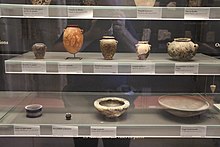
Artifacts of Egypt from the Prehistoric period, from 4400 to 3100 BC. Get-go row from top left: a Badarian ivory figurine, a Naqada jar, a Bat figurine. Second row: a diorite vase, a flint pocketknife, a corrective palette.
The prehistory of Egypt spans the period from the earliest human being settlement to the beginning of the Early Dynastic Period effectually 3100 BC, starting with the first Pharaoh, Narmer for some Egyptologists, Hor-Aha for others, with the name Menes besides maybe used for one of these kings. This Predynastic era is traditionally equivalent to the final part of the Neolithic period commencement c. 6000 BC and catastrophe in the Naqada 3 menstruation c. 3000 BC.
The dates of the Predynastic period were first divers earlier widespread archaeological excavation of Arab republic of egypt took place, and contempo finds indicating very gradual Predynastic development have led to controversy over when exactly the Predynastic period ended. Thus, various terms such as "Protodynastic flow", "Null Dynasty" or "Dynasty 0"[one] are used to name the part of the catamenia which might be characterized as Predynastic past some and Early Dynastic by others.
The Predynastic period is generally divided into cultural eras, each named afterward the place where a certain type of Egyptian settlement was beginning discovered. However, the same gradual development that characterizes the Protodynastic period is present throughout the entire Predynastic period, and individual "cultures" must not be interpreted as split up entities but as largely subjective divisions used to facilitate study of the entire period.
The vast majority of Predynastic archaeological finds accept been in Upper Arab republic of egypt, because the silt of the Nile River was more heavily deposited at the Delta region, completely burying most Delta sites long before mod times.[2]
Paleolithic [edit]
Excavation of the Nile has exposed early stone tools from the last million or and then years. The earliest of these lithic industries were located within a 30-metre (100 ft) terrace, and were archaic Acheulean, Abbevillian (Chellean) (c. 600,000 years ago), and an Egyptian form of the Clactonian (c. 400,000 years ago). Within the 15-metre (50 ft) terrace was adult Acheulean. Originally reported equally early Mousterian (c. 160,000 years agone) only since changed to Levalloisean, other implements were located in the 10-metre (thirty ft) terrace. The 4.5- and 3-metre (15–10 ft) terraces saw a more developed version of the Levalloisean, as well initially reported every bit an Egyptian version of Mousterian. An Egyptian version of the Aterian applied science was also located.[three]
Wadi Halfa [edit]

Aterian betoken from Zaccar, Djelfa region, Algeria.
Some of the oldest known structures were discovered in Egypt past archaeologist Waldemar Chmielewski along the southern border near Wadi Halfa, Sudan in Arkin viii site. Chmielewski dated the structures to 100,000 BC.[iv] The remains of the structures are oval depressions about xxx cm deep and two × i meters beyond. Many are lined with flat sandstone slabs which served equally tent rings supporting a dome-like shelter of skins or brush. This type of home provided a place to live, but if necessary, could be taken down easily and moved. They were mobile structures—easily disassembled, moved, and reassembled—providing hunter-gatherers with semi-permanent habitation.[4]
Aterian manufacture [edit]
Aterian tool-making reached Egypt c. xl,000 BC.[iv]
Khormusan industry [edit]
The Khormusan industry in Egypt began betwixt 42,000 and 32,000 BP.[4] Khormusans developed tools not merely from rock but also from animal bones and hematite.[iv] They also adult small pointer heads resembling those of Native Americans,[iv] simply no bows have been establish.[4] The end of the Khormusan industry came around 16,000 B.C. with the appearance of other cultures in the region, including the Gemaian.[5]
Late Paleolithic [edit]
The Late Paleolithic in Egypt started around 30,000 BC.[iv] The Nazlet Khater skeleton was found in 1980 and given an historic period of 33,000 years in 1982, based on ix samples ranging between 35,100 and 30,360 years sometime.[half-dozen] This specimen is the just complete modern human skeleton from the primeval Tardily Stone Age in Africa.[7]
Mesolithic [edit]
Halfan and Kubbaniyan culture [edit]

The Halfan and Kubbaniyan, two closely related industries, flourished along the Upper Nile Valley. Halfan sites are establish in the far due north of Sudan, whereas Kubbaniyan sites are establish in Upper Egypt. For the Halfan, only four radiocarbon dates have been produced. Schild and Wendorf (2014) discard the earliest and latest every bit erratic and conclude that the Halfan existed c. 22.five-22.0 ka cal BP.[8] People survived on a diet of big herd animals and the Khormusan tradition of fishing. Greater concentrations of artifacts indicate that they were non bound to seasonal wandering, merely settled for longer periods.[ citation needed ] The Halfan culture was derived in turn from the Khormusan,[a] [10] [ page needed ] which depended on specialized hunting, line-fishing, and collecting techniques for survival. The master material remains of this culture are stone tools, flakes, and a multitude of stone paintings.
Sebilian culture [edit]
In Arab republic of egypt, analyses of pollen institute at archaeological sites bespeak that the people of the Sebilian civilization (also known as the Esna culture) were gathering wheat and barley. The Sebilian culture began around 13,000 B.C and vanished around 10,000 B.C[ citation needed ] Domesticated seeds were non found.[11] It has been hypothesized that the sedentary lifestyle used by farmers led to increased warfare, which was detrimental to farming and brought this period to an finish.[eleven]
Qadan culture [edit]
The Qadan culture (13,000–ix,000 BC) was a Mesolithic manufacture that, archaeological evidence suggests, originated in Upper Egypt (present-mean solar day due south Egypt) approximately 15,000 years agone.[12] [13] The Qadan subsistence style is estimated to have persisted for approximately 4,000 years. It was characterized by hunting, also as a unique approach to food gathering that incorporated the training and consumption of wild grasses and grains.[12] [13] Systematic efforts were made by the Qadan people to water, care for, and harvest local plant life, but grains were not planted in ordered rows.[14]
Around xx archaeological sites in Upper Nubia give evidence for the existence of the Qadan civilisation's grain-grinding culture. Its makers also practiced wild grain harvesting along the Nile during the beginning of the Sahaba Daru Nile phase, when desiccation in the Sahara acquired residents of the Libyan oases to retreat into the Nile valley.[xi] Among the Qadan civilisation sites is the Jebel Sahaba cemetery, which has been dated to the Mesolithic.[fifteen]
Qadan peoples were the showtime to develop sickles and they also developed grinding stones independently to aid in the collecting and processing of these plant foods prior to consumption.[4] Notwithstanding, there are no indications of the employ of these tools after effectually x,000 BC, when hunter-gatherers replaced them.[4]
Harifian culture [edit]
The Harifians (8,800 BC – eight,000 BC) are viewed equally migrating out of the Fayyum[b] and the eastern deserts of Egypt (including Sinai) during the belatedly Mesolithic to merge with the Pre-Pottery Neolithic B (PPNB)[b] civilisation, whose tool assemblage resembles that of the Harifian. This assimilation led to the Circum-Arabian Nomadic Pastoral Circuitous, a group of cultures that invented nomadic pastoralism, and may take been the original civilization which spread Proto-Semitic languages throughout Mesopotamia.[xviii]
Neolithic [edit]
Lower Egypt [edit]
Faiyum A culture [edit]
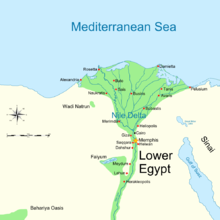
Continued expansion of the desert forced the early ancestors of the Egyptians to settle around the Nile more permanently and adopt a more sedentary lifestyle during the Neolithic.
The period from 9000 to 6000 BC has left very piffling in the style of archaeological evidence. Effectually 6000 BC, Neolithic settlements appear all over Egypt.[19] Studies based on morphological,[20] genetic,[21] [22] [23] [24] [25] and archaeological data[sixteen] [26] [27] [28] [29] accept attributed these settlements to migrants from the Fertile Crescent in the Almost East returning during the Egyptian and North African Neolithic, bringing agriculture to the region. Jared Diamond, in a non-scholarly work, proposes other regions in Africa independently developed agriculture at about the same time: the Ethiopian highlands, the Sahel, and West Africa.[30]
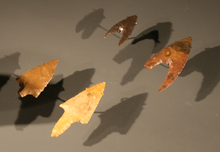
Arrowheads from Al Fayum.
Some morphological and postal service-cranial information has linked the earliest farming populations at Fayum, Merimde, and El-Badari, to Near Eastern populations.[31] [32] [33] However, the archaeological data also suggests that Near Eastern domesticates were incorporated into a pre-existing foraging strategy and only slowly developed into a full-blown lifestyle, contrary to what would be expected from settler colonists from the Nigh Eastward.[c] [35] [36] Finally, the names for the Nigh Eastern domesticates imported into Arab republic of egypt were non Sumerian or Proto-Semitic loan words,[37] which further diminishes the likelihood of a mass migrant colonization of lower Egypt during the transition to agriculture.[38]
Weaving is evidenced for the beginning time during the Faiyum A Period. People of this period, different later Egyptians, cached their dead very close to, and sometimes within, their settlements.[39]
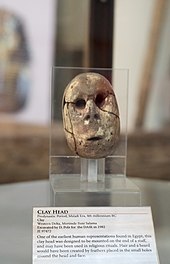
Merimde culture clay head, circa five,000 BC.[40] This is one of the primeval known representations of a human head in Egypt.
Although archaeological sites reveal very piddling about this time, an examination of the many Egyptian words for "city" provides a hypothetical list of causes of Egyptian sedentarism. In Upper Egypt, terminology indicates trade, protection of livestock, high ground for flood refuge, and sacred sites for deities.[41]
Merimde culture [edit]
From most 5000 to 4200 BC the Merimde culture, and then far only known from Merimde Beni Salama, a large settlement site at the border of the Western Delta, flourished in Lower Egypt. The culture has strong connections to the Faiyum A civilization also equally the Levant. People lived in small huts, produced a simple undecorated pottery and had stone tools. Cattle, sheep, goats and pigs were held. Wheat, sorghum and barley were planted. The Merimde people buried their dead within the settlement and produced clay figurines.[42] The commencement life-sized Egyptian head made of clay comes from Merimde.
El Omari culture [edit]
The El Omari culture is known from a small settlement near modern Cairo. People seem to take lived in huts, but only postholes and pits survive. The pottery is undecorated. Stone tools include small flakes, axes and sickles. Metal was not yet known.[43] Their sites were occupied from 4000 BC to the Archaic Period.[44]
Maadi civilization [edit]
The Maadi civilisation (likewise called Buto Maadi culture) is the about of import Lower Egyptian prehistoric culture dated well-nigh 4000 - 3500[46], and contemporary with Naqada I and Two phases in Upper Arab republic of egypt. The civilization is best known from the site Maadi nigh Cairo, but is also attested in many other places in the Delta to the Faiyum region. This civilisation was marked by development in architecture and technology. It as well followed its predecessor cultures when it comes to undecorated ceramics.[47]
Copper was known, and some copper adzes have been plant. The pottery is hand-made; it is elementary and undecorated. Presence of blackness-topped red pots indicate contact with the Naqada sites in the south. Many imported vessels from Palestine have besides been found. Black basalt stone vessels were also used.[48]
People lived in small huts, partly dug into the basis. The dead were buried in cemeteries, but with few burial goods. The Maadi culture was replaced past the Naqada 3 culture; whether this happened past conquest or infiltration is notwithstanding an open question.[49]
-
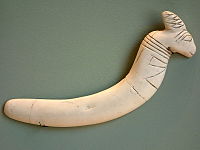
Clapper discovered in Maadi, Louvre Museum
-

Carved catfish bones, and jar discovered in Maadi
-

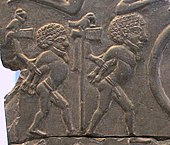
Possible prisoners and wounded men of the Buto-Maadi culture devoured by animals, while one is led by a man in long dress, probably an Egyptian official (fragment, meridian right corner). Battlefield Palette.[fifty] [51]
Upper Egypt [edit]
Nabta Playa [edit]
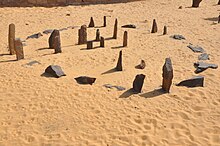
Nabta Playa "calendar circle", reconstructed at Aswan Nubia museum.
Nabta Playa was once a large internally drained basin in the Nubian Desert, located approximately 800 kilometers south of modern-twenty-four hour period Cairo[52] or about 100 kilometers west of Abu Simbel in southern Egypt,[53] 22.51° north, 30.73° east.[54] Today the region is characterized by numerous archaeological sites.[53] The Nabta Playa archaeological site, 1 of the earliest of the Egyptian Neolithic Menses, is dated to circa 7500 BC.[55] [56] Besides, excavations from Nabta Playa, located well-nigh 100 km west of Abu Simbel for example, suggest that the Neolithic inhabitants of the region were migrants from Sub-Saharan Africa.[57]
Tasian culture [edit]
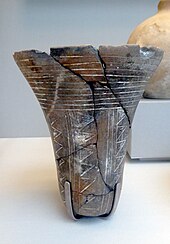
Tasian beaker, institute in a Badarian grave at Qau; tomb 569, around 4000 BC; Upper Egypt; British Museum
The Tasian civilisation was the next in Upper Egypt. This culture group is named for the burials plant at Der Tasa, on the e bank of the Nile between Asyut and Akhmim. The Tasian civilisation group is notable for producing the earliest blacktop-ware, a type of red and brown pottery that is colored black on the top portion and interior.[39] This pottery is vital to the dating of Predynastic Egypt. Considering all dates for the Predynastic menstruation are tenuous at best, WMF Petrie developed a system called sequence dating past which the relative date, if not the absolute date, of any given Predynastic site can be ascertained past examining its pottery.
As the Predynastic catamenia progressed, the handles on pottery evolved from functional to ornamental. The degree to which any given archaeological site has functional or ornamental pottery can also be used to make up one's mind the relative date of the site. Since there is little difference betwixt Tasian ceramics and Badarian pottery, the Tasian Culture overlaps the Badarian range significantly.[58] From the Tasian flow onward, it appears that Upper Egypt was influenced strongly by the culture of Lower Egypt.[59] Archaeological show has suggested that the Tasian and Badarian Nile Valley sites were a peripheral network of earlier African cultures that featured the movement of Badarian, Saharan, Nubian and Nilotic populations.[sixty]
Badarian culture [edit]
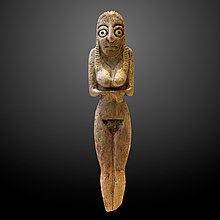
Ancient Badarian mortuary figurine of a woman, held at the Louvre
The Badarian civilisation, from about 4400 to 4000 BC,[61] is named for the Badari site nigh Der Tasa. It followed the Tasian civilisation, but was so similar that many consider them ane continuous period. The Badarian Civilization continued to produce the kind of pottery called blacktop-ware (albeit much improved in quality) and was assigned Sequence Dating numbers 21–29.[58] The master divergence that prevents scholars from merging the 2 periods is that Badarian sites utilize copper in addition to rock and are thus chalcolithic settlements, while the Neolithic Tasian sites are still considered Stone Age.[58]
Badarian flintstone tools continued to develop into sharper and more shapely blades, and the kickoff faience was developed.[62] Distinctly Badarian sites accept been located from Nekhen to a picayune due north of Abydos.[63] It appears that the Fayum A culture and the Badarian and Tasian Periods overlapped significantly; however, the Fayum A culture was considerably less agricultural and was yet Neolithic in nature.[62] [64]Cranial analysis and skeletal studies have shown strong biological affinities between Badarians and other African populations.[65] [66]
Dental trait analysis of Badarian fossils found that they were closely related to other Afroasiatic-speaking populations inhabiting Northeast Africa and the Maghreb. Amidst the ancient populations, the Badarians were nearest to other ancient Egyptians (Naqada, Hierakonpolis, Abydos and Kharga in Upper Egypt; Hawara in Lower Egypt), and C-Grouping and Pharaonic era skeletons excavated in Lower Nubia, followed by the A-Group culture bearers of Lower Nubia, the Kerma and Kush populations in Upper Nubia, the Meroitic, X-Grouping and Christian period inhabitants of Lower Nubia, and the Kellis population in the Dakhla Haven.[67] : 219–twenty Among the recent groups, the Badari markers were morphologically closest to the Shawia and Kabyle Berber populations of Algeria too as Bedouin groups in Kingdom of morocco, Great socialist people's libyan arab jamahiriya and Tunisia, followed by other Afroasiatic-speaking populations in the Horn of Africa.[67] : 222–4 The Late Roman era Badarian skeletons from Kellis were as well phenotypically distinct from those belonging to other populations in Sub-Saharan Africa.[67] : 231–2
Naqada civilisation [edit]
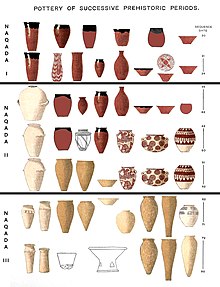
Evolution of Egyptian prehistoric pottery styles, from Naqada I to Naqada II and Naqada Iii
The Naqada culture is an archaeological culture of Chalcolithic Predynastic Egypt (c. 4000–3000 BC), named for the boondocks of Naqada, Qena Governorate. It is divided in three sub-periods: Naqada I, II and 3. A number of craniometric studies have found Naqada skeletal remains to have articulate, African affinities.[68] [69] [lxx] [71] In 1996, Lovell and Prowse reported the presence of individuals buried at Naqada in what they interpreted to exist elite, high condition tombs, showing them to be an endogamous ruling or elite segment who were significantly dissimilar from individuals buried in two other, obviously nonelite cemeteries, and more than closely related morphologically to populations in Northern Nubia than those in Southern Egypt.[72]
Amratian culture (Naqada I) [edit]

Ovoid Naqada I (Amratian) black-topped terracotta vase, (c. 3800-3500 BC).
The Amratian culture lasted from well-nigh 4000 to 3500 BC.[61] It is named after the site of El-Amra, about 120 km south of Badari. El-Amra is the first site where this culture group was found unmingled with the later Gerzean culture grouping, only this period is better attested at the Naqada site, and so it likewise is referred to as the Naqada I civilization.[62] Black-topped ware continues to appear, but white cantankerous-line ware, a type of pottery which has been busy with close parallel white lines being crossed by another prepare of close parallel white lines, is also institute at this fourth dimension. The Amratian menstruation falls between S.D. 30 and 39 in Petrie's Sequence Dating organization.[73]
Newly excavated objects adjure to increased trade between Upper and Lower Arab republic of egypt at this time. A stone vase from the north was found at el-Amra, and copper, which is not mined in Arab republic of egypt, was imported from the Sinai, or peradventure Nubia. Obsidian[74] and a small amount of gilded[73] were both definitely imported from Nubia. Trade with the oases also was likely.[74]
New innovations appeared in Amratian settlements as precursors to later cultural periods. For case, the mud-brick buildings for which the Gerzean catamenia is known were commencement seen in Amratian times, but only in small numbers.[75] Additionally, oval and theriomorphic cosmetic palettes announced in this period, but the workmanship is very rudimentary and the relief artwork for which they were after known is non yet present.[76] [77]
Gerzean culture (Naqada II) [edit]

A typical Naqada 2 pot with send theme
The Gerzean civilization, from virtually 3500 to 3200 BC,[61] is named after the site of Gerzeh. Information technology was the next phase in Egyptian cultural evolution, and it was during this time that the foundation of Dynastic Arab republic of egypt was laid. Gerzean culture is largely an unbroken development out of Amratian Culture, starting in the delta and moving due south through upper Egypt, but failing to dislodge Amratian culture in Nubia.[78] Gerzean pottery is assigned values from S.D. 40 through 62, and is distinctly different from Amratian white cross-lined wares or black-topped ware.[73] Gerzean pottery was painted generally in dark red with pictures of animals, people, and ships, equally well as geometric symbols that announced derived from animals.[78] As well, "wavy" handles, rare before this period (though occasionally found as early as S.D. 35) became more common and more elaborate until they were almost completely ornamental.[73]
Gerzean civilisation coincided with a significant decline in rainfall,[79] and farming along the Nile now produced the vast majority of food,[78] though contemporary paintings indicate that hunting was not entirely forgone. With increased food supplies, Egyptians adopted a much more sedentary lifestyle and cities grew every bit large as 5,000.[78]
It was in this fourth dimension that Egyptian city dwellers stopped building with reeds and began mass-producing mud bricks, first establish in the Amratian Period, to build their cities.[78]
Egyptian stone tools, while still in use, moved from bifacial construction to ripple-flaked construction. Copper was used for all kinds of tools,[78] and the first copper weaponry appears here.[63] Silver, gold, lapis, and faience were used ornamentally,[78] and the grinding palettes used for eye-paint since the Badarian period began to be adorned with relief carvings.[63]
The first tombs in classic Egyptian style were also congenital, modeled subsequently ordinary houses and sometimes composed of multiple rooms.[74] Although further excavations in the Delta are needed, this style is more often than not believed to originate there and not in Upper Egypt.[74]
Although the Gerzean Culture is now clearly identified as being the continuation of the Amratian menstruum, pregnant Mesopotamian influence worked its fashion into Egypt during the Gerzean, interpreted in previous years every bit evidence of a Mesopotamian ruling grade, the so-chosen Dynastic Race, coming to power over Upper Arab republic of egypt. This idea no longer attracts academic support.
Distinctly foreign objects and art forms entered Egypt during this period, indicating contacts with several parts of Asia. Objects such as the Gebel el-Arak knife handle, which has obviously Mesopotamian relief carvings on information technology, accept been found in Egypt,[82] and the silverish which appears in this menses can only have been obtained from Asia Minor.[78]

Naqada effigy of a adult female interpreted to represent the goddess Bat with her inward curving horns, c. 3500–3400 B.C.E. terracotta, painted, 11+ ane⁄2 in ×5+ 1⁄2 in ×2+ 1⁄iv in (29.2 cm × 14.0 cm × 5.7 cm), Brooklyn Museum
In addition, Egyptian objects are created which clearly mimic Mesopotamian forms, although non slavishly.[83] Cylinder seals appear in Egypt, equally well as recessed paneling architecture, the Egyptian reliefs on cosmetic palettes are clearly made in the same style as the contemporary Mesopotamian Uruk civilization, and the ceremonial mace heads which turn up from the late Gerzean and early on Semainean are crafted in the Mesopotamian "pear-shaped" style, instead of the Egyptian native style.[79]
The route of this trade is difficult to determine, simply contact with Canaan does non predate the early on dynastic, so it is usually assumed to take been conducted over water.[84] During the time when the Dynastic Race Theory was still popular, it was theorized that Uruk sailors circumnavigated Arabia, but a Mediterranean route, probably past middlemen through Byblos, is more than probable, as evidenced by the presence of Byblian objects in Arab republic of egypt.[84]
The fact that and then many Gerzean sites are at the mouths of wadis that lead to the Red Ocean may indicate some amount of trade via the Red Bounding main (though Byblian trade potentially could have crossed the Sinai then taken the Red Bounding main).[85] Also, it is considered unlikely that something so complicated every bit recessed panel compages could have worked its way into Arab republic of egypt by proxy, and at least a small contingent of migrants is often suspected.[84]
Despite this evidence of foreign influence, Egyptologists generally agree that the Gerzean Civilisation is still predominantly ethnic to Arab republic of egypt.
Protodynastic Period (Naqada Iii) [edit]

The Naqada III catamenia, from about 3200 to 3000 BC,[61] is generally taken to exist identical with the Protodynastic period, during which Egypt was unified.
Naqada Iii is notable for being the first era with hieroglyphs (though this is disputed by some), the first regular utilize of serekhs, the first irrigation, and the first appearance of royal cemeteries.[86]
The relatively affluent Maadi suburb of Cairo is congenital over the original Naqada stronghold.[87]
-

-
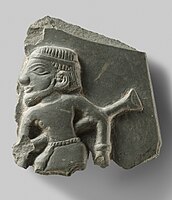
Fragment of a ceremonial palette illustrating a human being and a type of staff. Circa 3200–3100 BC, Predynastic, Late Naqada III.
Timeline [edit]
- (All dates are approximate)
- Tardily Paleolithic, from 40th millennium BC
- Aterian tool-making[4]
- Semi-permanent dwellings in Wadi Halfa[4]
- Tools fabricated from animate being bones, hematite, and other stones[4]
- Neolithic, from 11th millennium BC
- c. 10,500 BC: Wild grain harvesting along the Nile, grain-grinding culture creates earth's earliest stone sickle blades[4] roughly at end of Pleistocene
- c. 8000 BC: Migration of peoples to the Nile, developing a more centralized gild and settled agronomical economic system
- c. 7500 BC: Importing animals from Asia to Sahara
- c. 7000 BC: Agriculture—animate being and cereal—in East Sahara
- c. 7000 BC: in Nabta Playa deep year-round h2o wells dug, and large organized settlements designed in planned arrangements
- c. 6000 BC: Rudimentary ships (rowed, single-sailed) depicted in Egyptian stone art
- c. 5500 BC: Stone-roofed subterranean chambers and other subterranean complexes in Nabta Playa containing buried sacrificed cattle
- c. 5000 BC: Alleged archaeoastronomical rock megalith in Nabta Playa.[88] [89]
- c. 5000 BC: Badarian: furniture, tableware, models of rectangular houses, pots, dishes, cups, bowls, vases, figurines, combs
- c. 4400 BC: finely-woven linen fragment[90]
- From quaternary millennium BC, inventing has go prevalent
- c. 4000 BC: early Naqadan trade[91]
- 4th millennium BC: Gerzean tomb-building, including hole-and-corner rooms and burial of furniture and amulets
- 4th millennium BC: Cedar imported from Lebanon[ citation needed ]
- c. 3900 BC: An aridification event in the Sahara leads to human migration to the Nile Valley[92]
- c. 3500 BC: Lapis lazuli imported from Badakshan and / or Mesopotamia
- c. 3500 BC: Senet, world'southward oldest (confirmed) lath game
- c. 3500 BC: Faience, world's earliest-known glazed ceramic beads[ citation needed ]
- c. 3400 BC: Cosmetics,[ citation needed ] donkey domestication,[ commendation needed ] (meteoric) iron works,[93] mortar (masonry)
- c. 3300 BC: Double reed instruments and lyres (meet Music of Egypt)
- c. 3100 BC: Pharaoh Narmer, or Menes, or possibly Hor-Aha unified Upper and Lower Egypt
Relative chronology [edit]
See also [edit]
- 5.9 kiloyear event
- Prehistoric North Africa
Notes [edit]
- ^ The Khormusan is divers as a Middle Palaeolithic industry while the Halfan is defined equally an Epipalaeolithic industry. According to scholarly opinion, the Khormusan and the Halfan are viewed as separate and distinct cultures.[9]
- ^ a b Co-ordinate to scholarly opinion the Harifian culture is derived from the Natufian culture in which the only characteristic that distinguishes it from the Natufian is the Harif indicate. It is viewed every bit an adaptation of Natufian hunter gatherers to the Negev and Sinai.[16] The Harifian are thought to have lasted only virtually three hundred years, then vanishing, followed by a chiliad yr hiatus during which the Negev and Sinai regions were uninhabitable.[xvi] Since the Harifian culture ended c. 12,000 BP[17] there could exist no possible connection with the PPNB which began c. ten,500 BP.
- ^ Settler colonists from the Almost Eastward would most likely take merged with the indigenous cultures resulting in a mixed economy with the agricultural aspect of the economy increasing in frequency through time, which is what the archaeological record more than precisely indicates. Both pottery, lithics, and economic system with Most Eastern characteristics, and lithics with African characteristics are present in the Fayum A culture.[34]
References [edit]
- ^ Leprohon, Ronald, J. (2013). The great proper noun : aboriginal Egyptian royal titulary. Lodge of Biblical Literature. ISBN978-1-58983-735-five.
- ^ Redford, Donald B. (1992). Egypt, Canaan, and Israel in Ancient Times . Princeton: University Press. p. 10. ISBN9780691036069.
- ^ Langer, William Fifty., ed. (1972). An Encyclopedia of Earth History (fifth ed.). Boston, MA: Houghton Mifflin Company. p. ix. ISBN0-395-13592-three.
- ^ a b c d e f thousand h i j chiliad l m n "Ancient Egyptian Culture: Paleolithic Egypt". Emuseum. Minnesota: Minnesota Land University. Archived from the original on 1 June 2010. Retrieved 13 April 2012.
- ^ Nicolas-Christophe Grimal. A History of Ancient Egypt. p. twenty. Blackwell (1994). ISBN 0-631-19396-0
- ^ "Dental Anthropology" (PDF). Anthropology.osu.edu. Archived from the original (PDF) on 29 October 2013. Retrieved 25 October 2013.
- ^ Bouchneba, L.; Crevecoeur, I. (2009). "The inner ear of Nazlet Khater 2 (Upper Paleolithic, Egypt)". Periodical of Human Evolution. 56 (iii): 257–262. doi:10.1016/j.jhevol.2008.12.003. PMID 19144388.
- ^ R. Schild; F. Wendorf (2014). "Belatedly Palaeolithic Hunter-Gatherers in the Nile Valley of Nubia and Upper Arab republic of egypt". In East A. A. Garcea (ed.). South-Eastern Mediterranean Peoples Between 130,000 and x,000 years ago. Oxbow Books. pp. 89–125.
- ^ "Prehistory of Nubia". Numibia.net. Archived from the original on 29 Oct 2013. Retrieved 25 Oct 2013.
- ^ Reynes, Midant-Beatrix (2000). The Prehistory of Egypt: From the Starting time Egyptians to the First Pharohs. Wiley-Blackwell. ISBN0-631-21787-eight.
- ^ a b c Grimal, Nicolas (1988). A History of Ancient Egypt. Librairie Arthéme Fayard. p. 21.
- ^ a b Phillipson, DW: African Archaeology p. 149. Cambridge University Printing, 2005.
- ^ a b Shaw, I & Jameson, R: A Dictionary of Archaeology, p. 136. Blackwell Publishers Ltd, 2002.
- ^ Darvill, T: The Concise Oxford Dictionary of Archaeology, Copyright © 2002, 2003 by Oxford Academy Press.
- ^ Kelly, Raymond (October 2005). "The development of lethal intergroup violence". PNAS. 102 (43): 24–29. Bibcode:2005PNAS..10215294K. doi:x.1073/pnas.0505955102. PMC1266108. PMID 16129826.
- ^ a b c Bar Yosef, Ofer (1998). "The Natufian Civilisation in the Levant, Threshold to the Origins of Agriculture". Evolutionary Anthropology. 6 (5): 159–177. doi:10.1002/(sici)1520-6505(1998)six:5<159::aid-evan4>iii.0.co;2-7. S2CID 35814375.
- ^ Richter, Tobias; et al. (2011). "Interaction before Agronomics: Exchanging Textile and Sharing Cognition in the Final Pleistocene Levant" (PDF). Cambridge Archaeological Periodical. 21 (one): 95–114. doi:10.1017/S0959774311000060. S2CID 162887983.
- ^ Juris, Zarins (Nov 1990). "Early Pastoral Nomadism and the Settlement of Lower Mesopotamia". Bulletin of the American Schools of Oriental Inquiry (280): 31–65.
- ^ Redford, Donald B (1992). Egypt, Canaan, and Israel in Ancient Times . Princeton: University Press. p. 6. ISBN9780691036069.
- ^ Brace, C. Loring; Seguchi, Noriko; Quintyn, Conrad B.; Flim-flam, Sherry C.; Nelson, A. Russell; Manolis, Sotiris K.; Qifeng, Pan (2006). "The questionable contribution of the Neolithic and the Statuary Age to European craniofacial form". Proceedings of the National Academy of Sciences of the Usa. 103 (one): 242–247. Bibcode:2006PNAS..103..242B. doi:ten.1073/pnas.0509801102. PMC1325007. PMID 16371462.
- ^ Chicki, L; Nichols, RA; Barbujani, G; Beaumont, MA (2002). "Y genetic data support the Neolithic demic diffusion model". Proc. Natl. Acad. Sci. USA. 99 (17): 11008–11013. Bibcode:2002PNAS...9911008C. doi:10.1073/pnas.162158799. PMC123201. PMID 12167671.
- ^ "Estimating the Impact of Prehistoric Admixture on the Genome of Europeans, Dupanloup et al., 2004". Mbe.oxfordjournals.org. Archived from the original on eleven March 2007. Retrieved 1 May 2012.
- ^ Semino, O; Magri, C; Benuzzi, G; et al. (May 2004). "Origin, Diffusion, and Differentiation of Y-Chromosome Haplogroups E and J: Inferences on the Neolithization of Europe and Later Migratory Events in the Mediterranean Surface area, 2004". Am. J. Hum. Genet. 74 (5): 1023–34. doi:ten.1086/386295. PMC1181965. PMID 15069642.
- ^ Cavalli-Sforza (1997). "Paleolithic and Neolithic lineages in the European mitochondrial genetic pool". Am J Hum Genet. 61 (1): 247–54. doi:10.1016/S0002-9297(07)64303-one. PMC1715849. PMID 9246011. Retrieved ane May 2012.
- ^ Chikhi (21 July 1998). "Clines of nuclear Dna markers suggest a largely Neolithic ancestry of the European cistron". PNAS. 95 (15): 9053–9058. Bibcode:1998PNAS...95.9053C. doi:x.1073/pnas.95.fifteen.9053. PMC21201. PMID 9671803.
- ^ Zvelebil, Grand. (1986). Hunters in Transition: Mesolithic Societies and the Transition to Farming. Cambridge, Uk: Cambridge University Printing. pp. v–15, 167–188.
- ^ Bellwood, P. (2005). Showtime Farmers: The Origins of Agricultural Societies. Malden, MA: Blackwell.
- ^ Dokládal, M.; Brožek, J. (1961). "Physical Anthropology in Czechoslovakia: Contempo Developments". Current Anthropology. two (5): 455–477. doi:10.1086/200228. S2CID 161324951.
- ^ Zvelebil, Chiliad. (1989). "On the transition to farming in Europe, or what was spreading with the Neolithic: a reply to Ammerman (1989)". Antiquity. 63 (239): 379–383. doi:ten.1017/S0003598X00076110.
- ^ Diamond, Jared (1999). Guns, Germs, and Steel. New York: Norton Press. ISBN0-393-31755-two.
- ^ Smith, P. (2002) The palaeo-biological prove for admixture between populations in the southern Levant and Arab republic of egypt in the fourth to third millennia BCE. In: Egypt and the Levant: Interrelations from the quaternary through the Early 3rd Millennium BCE, London–New York: Leicester University Press, 118–128
- ^ Keita, S.O.Y. (2005). "Early Nile Valley Farmers from El-Badari: Aboriginals or "European" Agro-Nostratic Immigrants? Craniometric Affinities Considered With Other Information". Journal of Black Studies. 36 (2): 191–208. doi:10.1177/0021934704265912. S2CID 144482802.
- ^ Kemp, B. 2005 "Ancient Arab republic of egypt Beefcake of a Civilisation". Routledge. p. 52–threescore
- ^ Shirai, Noriyuki (2010). The Archaeology of the First Farmer-Herders in Egypt: New Insights into the Fayum Epipalaeolithic. Archaeological Studies Leiden Academy. Leiden Academy Printing.
- ^ Wetterstrom, W. (1993). Shaw, T.; et al. (eds.). Archaeology of Africa. London: Routledge. pp. 165–226.
- ^ Rahmani, North. (2003). "Le Capsien typique et le Capsien supérieur". Cambridge Monographs in Archaeology. Cambridge: Cambridge University Printing (57).
- ^ Keita, S. O. Y.; Boyce, A. J. (2005). "Genetics, Egypt and History: Interpreting Geographical Patterns of a Y-Chromosome Variation". History in Africa. 32: 221–46. doi:10.1353/hia.2005.0013. S2CID 163020672.
- ^ Ehret, C; Keita, SOY; Newman, P (2004). "The Origins of Afroasiatic a response to Diamond and Bellwood (2003)". Science. 306 (5702): 1680. doi:10.1126/scientific discipline.306.5702.1680c. PMID 15576591. S2CID 8057990.
- ^ a b Gardiner, Alan (1964). Egypt of the Pharaohs. Oxford: University Press. p. 388.
- ^ Josephson, Jack. "Naqada IId, Nascency of an Empire": 173.
- ^ Redford, Donald B. (1992). Egypt, Canaan, and Israel in Ancient Times . Princeton: Academy Press. p. 8. ISBN9780691036069.
- ^ Eiwanger, Josef (1999). "Merimde Beni-salame". In Bard, Kathryn A. (ed.). Encyclopedia of the Archaeology of Aboriginal Egypt . London/New York. pp. 501–505. ISBN9780415185899.
- ^ Mortensen, Bodil (1999). "el-Omari". In Bard, Kathryn A. (ed.). Encyclopedia of the Archaeology of Ancient Arab republic of egypt . London/New York. pp. 592–594. ISBN9780415185899.
- ^ "El-Omari". EMuseum. Mankato: Minnesota Country Academy. Archived from the original on fifteen June 2010.
- ^ Brovarski, Edward. "REFLECTIONS ON THE Battleground AND LIBYAN BOOTY PALETTES": 89.
- ^ Maadi. University College London
- ^ "Predynastic Period in Egypt". Globe History Encyclopedia . Retrieved 14 Nov 2017.
- ^ Maadi. Academy College London
- ^ Seeher, Jürgen (1999). "Ma'adi and Wadi Digla". In Bard, Kathryn A. (ed.). Encyclopedia of the Archaeology of Ancient Egypt . London/New York. pp. 455–458. ISBN9780415185899.
- ^ Brovarski, Edward. "REFLECTIONS ON THE BATTLEFIELD AND LIBYAN Booty PALETTES": 89.
- ^ Davis, Whitney; Davis, George C. and Helen Due north. Pardee Professor of Art Historyancient Modern & Theory Whitney; Davis, Whitney 1000. (1992). Masking the Blow: The Scene of Representation in Late Prehistoric Egyptian Art. University of California Press. p. 264. ISBN978-0-520-07488-0.
- ^ Slayman, Andrew Fifty. (27 May 1998), Neolithic Skywatchers, Archaeological Establish of America
- ^ a b Wendorf, Fred; Schild, Romuald (26 Nov 2000), Late Neolithic megalithic structures at Nabta Playa (Sahara), southwestern Egypt, Comparative Archeology Web, archived from the original on 6 August 2011
- ^ Brophy, TG; Rosen PA (2005). "Satellite Imagery Measures of the Astronomically Aligned Megaliths at Nabta Playa" (PDF). Mediterranean Archaeology and Archaeometry. 5 (1): 15–24. Archived from the original (PDF) on 29 February 2008.
- ^ Margueron, Jean-Claude (2012). Le Proche-Orient et fifty'Égypte antiques (in French). Hachette Éducation. p. 380. ISBN9782011400963.
- ^ Wendorf, Fred; Schild, Romuald (2013). Holocene Settlement of the Egyptian Sahara: Book ane: The Archaeology of Nabta Playa. Springer Science & Business Media. pp. 51–53. ISBN9781461506539.
- ^ Wendorf, Fred (2001). Holocene settlement of the Egyptian Sahara. New York: Kluwer Academic/Plenum Publishers. pp. 489–502. ISBN978-0-306-46612-0.
- ^ a b c Gardiner, Alan, Arab republic of egypt of the Pharaohs (Oxford: University Press, 1964), p. 389.
- ^ Grimal, Nicolas. A History of Aboriginal Egypt. p.35. Librairie Arthéme Fayard, 1988.
- ^ Egypt in its African context : proceedings of the conference held at the Manchester Museum, University of Manchester, 2-4 October 2009. Oxford: Archaeopress. 2011. pp. 43–54. ISBN978-1407307602.
- ^ a b c d Shaw, Ian, ed. (2000). The Oxford History of Ancient Egypt. Oxford University Press. p. 479. ISBN0-nineteen-815034-2.
- ^ a b c Grimal, Nicolas. A History of Aboriginal Arab republic of egypt. p.24. Librairie Arthéme Fayard, 1988
- ^ a b c Gardiner, Alan, Arab republic of egypt of the Pharaohs (Oxford: University Press, 1964), p. 391.
- ^ Newell, G.D. "A re-examination of the Badarian Culture" Academia.edu, 2012
- ^ Keita, S. O. Y. (2005). "Early Nile Valley Farmers From El-Badari: Aboriginals or "European" Agro-Nostratic Immigrants? Craniometric Affinities Considered With Other Data". Journal of Black Studies. 36 (2): 191–208. ISSN 0021-9347.
- ^ Godde, Kanya. "A biological perspective of the relationship between Egypt, Nubia, and the Most Eastward during the Predynastic menstruum". Retrieved 20 February 2022.
- ^ a b c Haddow, Scott Donald. "Dental Morphological Analysis of Roman Era Burials from the Dakhleh Oasis, Egypt". Plant of Archaeology, University College London. Retrieved 2 June 2017.
- ^ Keita, South. O. Y. (1993). "Studies and Comments on Ancient Egyptian Biological Relationships". History in Africa. twenty: 129–154. doi:10.2307/3171969. ISSN 0361-5413.
- ^ Keita, Shomarka. "Analysis of Naqada Predynastic Crania: a brief report (1996)" (PDF).
- ^ Godde, 1000. (2009). "An examination of Nubian and Egyptian biological distances: support for biological diffusion or in situ development?". Human being: Internationale Zeitschrift Fur Die Vergleichende Forschung Am Menschen. 60 (5): 389–404. doi:10.1016/j.jchb.2009.08.003. ISSN 1618-1301.
- ^ Godde, Kanya. "A biological perspective of the relationship between Egypt, Nubia, and the About Due east during the Predynastic period (2020)".
- ^ Lovell Nancy and Prowse Tracy (17 December 2012). "Concordance of cranial and dental morphological traits and evidence f…". archive.ph.
- ^ a b c d Gardiner, Alan, Arab republic of egypt of the Pharaohs (Oxford: University Press, 1964), p. 390.
- ^ a b c d Grimal, Nicolas. A History of Aboriginal Egypt. p. 28. Librairie Arthéme Fayard, 1988
- ^ Redford, Donald B. Egypt, Canaan, and Israel in Ancient Times. Princeton: University Press, 1992, p. vii.
- ^ Gardiner, Alan, Arab republic of egypt of the Pharaohs. Oxford: Academy Printing, 1964, p. 393.
- ^ Newell, G. D., "The Relative chronology of PNC I" (Academia.Edu: 2012)
- ^ a b c d e f yard h Redford, Donald B. Egypt, Canaan, and Israel in Ancient Times. (Princeton: University Press, 1992), p. sixteen.
- ^ a b Redford, Donald B. Egypt, Canaan, and Israel in Aboriginal Times. (Princeton: University Printing, 1992), p. 17.
- ^ a b "Site officiel du musée du Louvre". cartelfr.louvre.fr.
- ^ Cooper, Jerrol S. (1996). The Study of the Ancient About East in the Twenty-first Century: The William Foxwell Albright Centennial Conference. Eisenbrauns. pp. 10–14. ISBN9780931464966.
- ^ Shaw, Ian. & Nicholson, Paul, The Dictionary of Ancient Arab republic of egypt, (London: British Museum Press, 1995), p. 109.
- ^ Redford, Donald B. Egypt, Canaan, and State of israel in Ancient Times. (Princeton: University Press, 1992), p. xviii.
- ^ a b c Redford, Donald B. Egypt, Canaan, and Israel in Aboriginal Times. (Princeton: Academy Printing, 1992), p. 22.
- ^ Redford, Donald B. Egypt, Canaan, and Israel in Ancient Times. (Princeton: University Press, 1992), p. 20.
- ^ "Naqada III". Faiyum.com. Retrieved 1 May 2012.
- ^ "Maadi Culture". www.ucl.ac.uk . Retrieved 3 April 2018.
- ^ Malville, J. McKim (2015), "Astronomy at Nabta Playa, Egypt", in Ruggles, C.Fifty.N. (ed.), Handbook of Archaeoastronomy and Ethnoastronomy, vol. 2, New York: Springer Science+Business Media, pp. 1079–1091, ISBN978-ane-4614-6140-1
- ^ Belmonte, Juan Antonio (2010), "Ancient Egypt", in Ruggles, Clive; Cotte, Michel (eds.), Heritage Sites of Astronomy and Archaeoastronomy in the context of the UNESCO World Heritage Convention: A Thematic Study, Paris: International Quango on Monuments and Sites/International Astronomical Union, pp. 119–129, ISBN978-two-918086-07-ix
- ^ "linen fragment". Digitalegypt.ucl.ac.united kingdom of great britain and northern ireland. Retrieved 1 May 2012.
- ^ Shaw (2000), p. 61
- ^ Brooks, Nick (2006). "Cultural responses to aridity in the Middle Holocene and increased social complication". Quaternary International. 151 (1): 29–49. Bibcode:2006QuInt.151...29B. doi:ten.1016/j.quaint.2006.01.013.
- ^ "Iron beads were worn in Arab republic of egypt as early as 4000 B.C., but these were of meteoric iron, manifestly shaped by the rubbing process used in shaping implements of rock", quoted under the heading "Columbia Encyclopedia: Iron Age" at Iron Age, Answers.com. Likewise, see History of ferrous metallurgy#Meteoritic atomic number 26—"Effectually 4000 BC small items, such as the tips of spears and ornaments, were beingness fashioned from iron recovered from meteorites" – attributed to R. F. Tylecote, A History of Metallurgy (2nd edition, 1992), p. 3.
External links [edit]
- Information about Aboriginal Egyptian History : from This Is Egypt | Information about Ancient Egyptian History
- Ancient Egyptian History - A comprehensive and curtailed educational website focusing on the basic and the advanced in all aspects of Aboriginal Egypt
- Faium.com homepage
- Before the Pyramids: The Origins of Egyptian Civilization - Oriental Institute
Source: https://en.wikipedia.org/wiki/Prehistoric_Egypt
0 Response to "What Is the Difference Between Art Clay Silver and Pmc"
Postar um comentário