Again Refer to Carroll Clinics 2016 Operating Budget
Updated July 30, 2015: Comments on the discussion at today'due south meeting take been added.
The Budget Committee met today and received the presentation linked from the primary article. There was considerable debate, a welcome change from the Stintz/Ford years at the TTC where detailed knowledge of the budget was not of much interest to politicians. Now there actually is a Budget Committee, and its members take their job seriously. The idea is that by the time the upkeep hits Council, there volition be a group of informed advocates across the senior staff who, in past years, take been left to fend every bit all-time they could as proponents of better transit in a hostile environment.
Amidst the topics that came up were:
- the question of the "average fare" and the role of a monthly pass in the fare mix;
- the time to come role of and arrangements for fare collection with Presto;
- the implications of various possible fare schemes, including increases, and the resulting effect on the TTC upkeep and subsidy requirement;
- the provision of improved service, its price and its beneficiaries;
- the staffing of TTC and particularly the numbers of new staff and their cost for various functions.
The "Average Fare"
An ongoing issue with TTC financial reporting is that information technology measures revenue "per ride", the tradition metric and one which is used to compare transit systems with each other. In that location are three primal problems with this arroyo:
- With the rise of various forms of unlimited ride media, notably but not exclusively passes, the definition of a "ride" is getting softer. For example, if one makes a stopover that is not permitted by the TTC's strict transfer rules, but is riding with a pass, does a new "ride" get-go every time ane pops into Tim Horton'south while waiting for the Queen motorcar to show up? If one "fare" buys a limited time pass (e.g. the "2 hour transfer"), how should that fare be counted? (There are many other variations on this theme.) When the TTC calibrates the usage multiple for Metropasses, practice they employ the more restrictive "transfer rules" definition of a "ride" and thereby inflate the assumed number of single fares a rider might otherwise be paying?
- With half of all adult fare TTC travel now taken with a Metropass, what is the "bones fare"? Does the adult ticket or cash charge per unit make sense today as a reference value? Fares below the adult charge per unit are ever referred to as "discounted" when in fact it may exist the single-token or cash rider who is paying a premium over the typical fare.
- The marginal cost of providing capacity for a "ride" varies depending on where and when information technology is taken. Although the average "ride" on the TTC may cost over $iii.23 (total 2016 expenses of $1.795b divided by 555m riders), the marginal price of many rides is zero because they consume excess capacity. Conversely, the marginal cost of some rides is very loftier because they trigger the demand for more service, vehicles, operators and infrastructure. Saying that each new "ride" costs over $ane in subsidy completely obscures this range of costs.
A corollary to this viewpoint is that Metropass users, since the solar day they were introduced, reluctantly, in May 1980, take been seen as "beating the system" and paying a lower fare than they should. This is a very important consideration: the presumption that somehow pass users are not entitled to their lower fare even though passes have many benefits and frequent users of the system are rewarded for their "transit habit". The marginal cost of the "extra" trips beyond the (roughly) fifty-fare suspension even betoken is much less than "n" times the average cost/ride because those trips tend to be taken at times and locations where there is free capacity.
Every bit long every bit the TTC debates fares from the premise, an ideal, that everyone pays the same "full" fare, the discussion is backwards, peculiarly in an era when the goal of a transit arrangement is to encourage more travel both for mobility and to reduce traffic congestion from trips that might otherwise apply an car. Mobility benefits take a value, and increased traffic has a price, just neither of these prove up in the TTC's budget.
With the future motility to Presto, Toronto could well have a situation where 75% of riders are travelling on some sort of "loyalty" program whether information technology be a monthly subscription to unlimited travel within a specified expanse, or a "capping" mechanism such that daily, weekly and monthly costs never exceed certain levels. In this environment, "riders" completely lose their traditional meaning, and the of import metric becomes "how many Presto users do you have" and "how much acquirement do yous get from the average user". Ridership has a meaning for service planning: is the bus total, and is the service design advisable to the demand, but these are split from the question of acquirement.
The committee'southward discussion touched on, but did non fully illuminate this issue, in part because TTC staff are wedded to the traditional model of counting riders and describing "full" vs "discounted" fares. This leads into problems with the perception that every new ride costs Toronto more subsidy, an oft-repeated comment that is well wide of the mark.
Presto and Future Fare Structures
By the starting time of 2017, the TTC hopes to have its system completely Presto-enabled. Whether or not they make that target remains to exist seen, just in that location are a few critical discussions and decisions that must occur in the nearly future:
- Once Presto is the primary method of fare drove, the TTC has the choice to look at various schemes for graduated fares. Not only could at that place be equivalents to the electric current "pass" construction, just too time-of-day pricing, time-based transfers, and fare integration (whatever that may look like) with other GTHA systems including Go Transit. TTC staff will bring a report to the Commission in fall 2015 discussing the various options in detail, and the Upkeep Committee has asked that this come to them first and then that it can be understood in depth before a full lath debate and a recommendation to Council through the budget. The bodily transition to a new fare scheme is not likely to occur before 2017 when the system volition no longer be in "mixed mode" of Presto-based and legacy fares. The discussion, however, must take place now in preparation for the furnishings on a 2017 budget.
- During 2016, the TTC will exist supporting both its erstwhile and new fare collection mechanisms, merely once the transition to Presto is underway, in that location volition be a large redeployment of staff functions. The most obvious is for station collectors, simply at that place is also a small army of people who bargain with fare handling and cash, and the associated fare mechanism. A cracking deal of this volition pass to Presto itself, and the TTC will simply purchase support for the fare system via the 5.5% service fee on all fare acquirement Presto collects. Whatever savings will be offset past deployment of fare inspectors and station staff in a customer service role. Again this is a plan for time to come years, only the details must be discussed and agreed to up forepart.
Culling Fare Schemes and the City Subsidy
The discussion took an unfortunate turn because, inevitably, a member of the committee, Commissioner and City Ward 4 Councillor John Campbell, wanted to talk about a budget that would non require an increase to the Urban center's subsidy. Thanks to the demonization of the Metropass, he seized on this as a possible opportunity to review whether the TTC should even have passes. This shows the danger of the misrepresentation of the "cost" of passes and of increased ridership they represent.
The typical Metropass rider takes over 70 trips per month by the TTC's count, and with a pause-fifty-fifty point of about 50, this means that their boilerplate fare is most ii/3 that of a "full adult" fare rider. If (a) they continued to ride at the same rate and (b) the pass were not available, the net effect would be a 50% increment in their fares. That's a wonderful way to treat the most loyal of TTC riders who consume 50% of the "rides" on the organisation. Such a proposal is consummate madness, and runs counter to the "all y'all tin can consume" footing on which fares are charged with various forms of bulk disbelieve all over the world.
The commission adopted a motion from Chair Colle asking that staff bring back a study on various scenarios for a fare increment. What was not articulate from the motion would exist whether the intent is to completely make up the budget shortfall from fares, or whether various options involving a greater or lesser contribution from fares is the goal of the asking.
The Human relationship of Service Improvements, Costs and Marginal Ridership Changes
Just the 24-hour interval earlier, the full TTC Board approved the improvement of off-peak loading standards on its most frequent services to, in consequence, reduce by twenty% the target average load on vehicles. (The onetime standard was a seated load plus 25%, and the new standard is only a seated load.) This reverses a alter implemented nether the Ford regime and has benefits on the heaviest routes in reduced crowding, improved attractiveness of service, and provision of room for ridership growth.
Other changes that have been recently approved include:
- Implementation of a "ten infinitesimal network" with headways no wider than 10 minutes on a core network of routes at all hours except overnight. In practice, this does non represent a big change because near of the affected routes already have "frequent service" (10 minutes or amend) at nearly times of the solar day.
- Restoration of full service on most routes that were cutting dorsum early on in the Ford era then that service is provided on all days during nigh of the menses that the subway is open (typically with a 1:00 am cutoff on the lighter routes).
- Addition of new Blue Night routes and so that service is within a fifteen infinitesimal walking altitude of about areas in Toronto.
Each of these changes has a cost both in dollars and in increased headcount, together with a projected ridership increase. The fence veered off into a word of how much the TTC would be spending to acquire new riders, just the vital point that was completely missed is that the new services and standards improve the lot of all riders on the afflicted routes. The population of affected riders is much greater than the marginal growth of ridership in the offset year of operation for the improvements. Again the problem is one of perceived loftier cost when the beneficiaries of a alter are not fully best-selling.
From the written report on improved crowding standards at the July 29, 2015 board meeting:
Funding in the amount of $three.two meg is included in the TTC's 2015 Operating Budget to operate this improved service from September to December, 2015. This additional expense will exist partially offset by an increase in fare revenue in 2015, from increased ridership, of up to $one.2 million. The improvements will increase operating costs by approximately $9.nine 1000000 annually, in 2016 and beyond. Increased ridership attracted past this service comeback will partially showtime additional operating expense, with an annual increment in fare revenue of $3.6 million. [p. 2]
This service initiative will benefit approximately 55 one thousand thousand customer-trips each twelvemonth that are now fabricated on these services, and will concenter an estimated 1.eight million new client-trips each year. This service improvement largely reverses off-peak service cuts that were made in Feb 2012, when the crowding standard at off-peak times was increased, resulting in off-peak service reductions on 37 routes. [p. 5]
The Commission approved this less than 24 hours earlier the Budget Committee debate, although information technology is unclear whether some members understood the implication. When the Mayor and some members of Council choose to hold a photo op to denote this type of improvement, in that location is a cost, and it is unfathomable that a Commissioner would cramp at funding the cost of so well-publicized an improvement.
The new standards are only expected to draw 1.8m new trips, but the added comfort and shorter waiting times of less-crowded buses and streetcars will benefit the 55m trips taken on the affected routes, or nearly 10% of all TTC trips. The cost of this improvement should be measured against this 55m, not against the ane.8m marginal increase in rides. A related benefit is that this volition provide headroom for growth so that new trips can exist handled on moderately well loaded, rather than stuffed vehicles, and this has long-term implications for the attractiveness of transit every bit a travel style. People are used to the thought that the subway provides very frequent and frequently uncrowded service until 2:00 am over the full network. Meanwhile proponents of "efficiency" in service delivery portray empty space on surface vehicles (which acquit over half of the TTC's riders) every bit an evil that must be eradicated. Nosotros should not waste matter service, only the stardom is that transit must be attractive enough not to exist seen every bit a final resort.
Upkeep Adjustments and Clarifications
During the presentation, we learned that the TTC has now brought its futurity diesel fuel contracts to 90% of projected 2016 requirements through hedging, and the expected cost is $five million less than projected in the preliminary upkeep (lowering the preliminary shortfall from $99m to $94m). This sort of change is not unusual at this stage of budget presentation, especially because that the total expenditure budget is $1.8 billion.
Future Piece of work by the Budget Committee
Members of the commission expressed a strong interest in a "deep dive" into specific aspects of TTC budgets (both operating and capital) including topics such as fleet planning and a "naught-based" view of workforce planning. This is fundamentally dissimilar from the high-level budget presentations which identify year-to-year changes, but get out out the base of operations data. Such work will not necessarily precede completion of the 2016 budget, but the commission'due south hope is to develop expertise in various aspects of the TTC'due south budgeting so that they can sympathise the options and challenges facing the system in coming years.
1 major topic that will inevitably come to both the TTC and to Council will be the question of peak period loading standards. This is not addressed in the 2016 budget because there are no spare vehicles with which to better average loads. We already know that in that location are plans for new express services using buses on order that will arrive starting in Dec 2015, just beyond this, the specifics of further meridian improvements have yet to be discussed. The marginal price of such improvements is very high because they will crave more vehicles, more staff and more infrastructure (maintenance and storage infinite). By contrast, the marginal cost of off-height improvements implemented in 2015 is insufficiently low because the vehicles are already here, and even commuter costs come in at less than average levels because better off-tiptop service improves staff utilization (less garage mileage between the peaks, and more than "straight through" work schedules).
A more thorough understanding of the factors affecting the toll and mechanics of providing transit service at the TTC Board level will be essential to an informed process of rebuilding transit'southward brownie in Toronto.
The original article follows beneath:
Updated July 29, 2015: A department has been added showing the TTC's projections for the 2016 budget that were included in the 2015 package.
On July 30, 2015, the TTC Budget Commission volition have a first look at the 2016 Operating Budgets.
This budget will be an of import examination for the Commission and for Council because policies set in motility in 2015 will now accept full-year effects in 2016 and across. These crave ongoing funding, not a former "Eureka!" moment where the sins of the past administration are finally recognized for their consequence. If Council chooses not to fund the cost of its new policies, we volition know just how serious Toronto really is about sustained improvement of the transit system.
Year-to-year changes in the budget arise from various factors, and these collaborate to produce the final estimates:
- Ridership projections based on economic factors, and on the added riding induced past service improvements.
- Full-yr effects of changes such as fares and services implemented mid-way through 2015 including new Service Standards that require more service to provide more than attractive and comfortable service.
- Changes in maintenance standards to improve service reliability.
- Changes in fare collection procedures.
- Inflationary increases in wages and material costs.
The ridership projection for 2016 is summarized beneath:

The original projection for 2015 was 545 million rides, but this has been scaled back primarily because of the issue of the bad winter, greater than expected loss from the fare increase, and lower than expected economic growth. For 2016, the projection is an additional 15 1000000 rides bringing the projected total to 555 one thousand thousand.
Fares are overwhelmingly the largest part of TTC revenues. I might argue that there is "gold" to be mined from some of the ancilliary sources, the fact is that even a doubling of any of these would yield very picayune, and would only shave a pocket-sized amount off of the requirement for subsidy. TTC does not expect much increase in these areas in part because some of the income streams are set by contractual arrangements.

Annotation that the chart above and all other material in the Preliminary Budget has been prepared on the supposition of the existing fare construction. A fare increase is a separate event, and I will plough to that subsequently in the article.
Service provision requires operators to drive vehicles, mechanics to maintain them and the infrastructure, free energy to propel vehicles, and a variety of other costs. In 2016, there will exist a one-fourth dimension effect from the opening of Leslie Barns and the transitional presence of both the onetime CLRV/ALRV fleets and the new Flexity streetcars.
The Presto rollout volition continue, simply TTC is non yet at the point where savings from changes to their fare processing and greenbacks handling tin can be built into the budget.
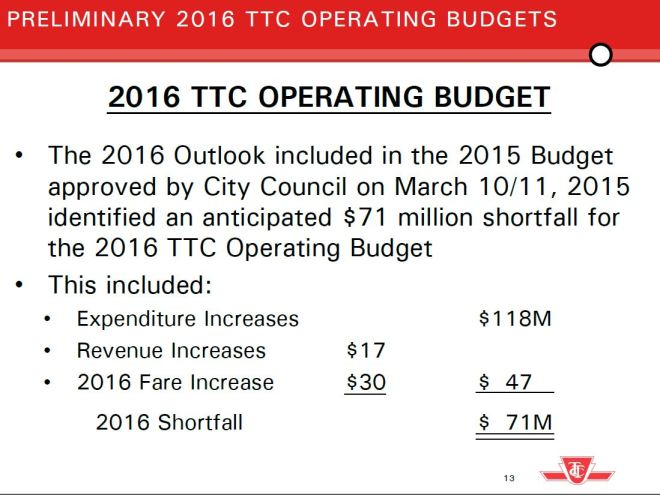
The preliminary operating budget will require $99 million more in subsidy (before any fare increase) than in 2015, an increase of about 21% that is leap to drive the budget hawks on Council mad.

This is the inevitable upkeep arithmetic:
- Expenses get up because there are more riders
- Expenses go up because the quality of service has been improved
- Expenses go up considering of inflation
These three items compound into a year-over-year value that is not the simple inflationary increase of a few pct many on Council hope to see, and certainly not the 2% reduction asked for past Mayor Tory.
If Council gives the TTC 2% more than subsidy for 2016, this would exist $9.48 million, but nowhere near the $99 million they need. Every bit, if Quango were to cut the subsidy by 2%, it would decline past the same amount leaving an even bigger hole for the TTC to fill.
The fare revenue increase shown above is the combined outcome of more riders in 2016, simply riding at a slightly decreased average fare because of the uptake of Metropasses as the preferred payment method. Supposing that the TTC were left with $xc 1000000 to detect (later on a $10 million crash-land from the City), this would require a vii.8% fare increment (with no allowance for lost ridership). A lower fare increase requires a higher subsidy, or a determination to curl dorsum some of the service improvements that are merely now at the announcement phase, not even yet on the streets.
For reference, a 1% increment in property taxes yields about $30 million in acquirement. If the Urban center were to give the TTC $twoscore meg more (the original 2%/$10m plus some other $30m), this would nevertheless leave the farebox to provide $60 1000000, or a 5.2% fare increase. There will take to be some hard discussions well-nigh the fact that we must at present really pay for all of those photo ops and service improvements launched in 2015. (This is as well an example of an ongoing shortcoming in a lot of budgeting in that the TTC did not produce a futurity year budget showing what 2016 might look similar with the combined event of the factors listed above.)
The revenue increase, such as it is, and with no fare increment included, works out similar this:

Although there volition be an increment in advertising revenue of $2 million, this is expected to be offset past lower parking revenue and a reduction in contract/charter services (mainly YRT services).
Updated July 29, 2015 at 11:xxx am:
Council was warned of the impending need for greater subsidy during the 2015 budget bicycle. The 2016 increase in fare revenue is based on five cents on the regular adult fare. The fence will inevitably plough on whether to load more than of the revenue requirement onto fares, onto taxes, or onto nonetheless more demands for "efficiency" without actually cutting service. Small amounts may be plant around the edges, the the total required is too much to achieve just through political posturing and judicious trimming of office supplies.
The shortfall of $99m shown above is, assuasive for the lack of a fare increment in the preliminary budget, almost identical to what was forecast.
The overall expenses upkeep:

Expenses go up a lot more than than revenues:
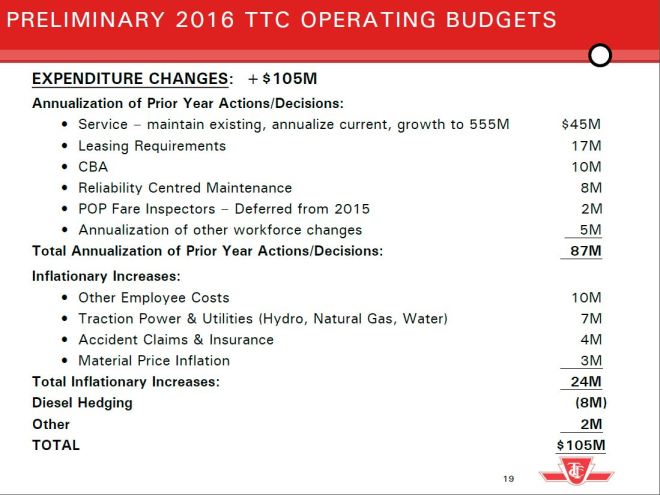
Of the $105 million added on the expense side of the budget, $87 million comes from the decisions taken for 2015. About half of this is the combined value of full-year operation of the service improvements, plus the additional service triggered by x million more rides.
Leasing costs relate to the 50-bus facility in York Region that the TTC volition begin using in 2016, as well as a proposed 250-motorbus facility (this has not nevertheless been identified and would be a part-year expense), a new warehouse, and additional office infinite.
"CBA" refers to the increase from the Collective Bargaining Agreements.
"Reliability Centred Maintenance" refers to a new program past which the TTC pro-actively performs maintenance and parts replacement before the anticipated time of failure rather than letting vehicles fail in service. A related factor hither is the increase of the motorcoach spare ratio so that more vehicles are available for routine maintenance rather than being pushed out of the garages into service.
Pop Inspectors did not increase in 2015 equally originally expected, and with the slow rollout of new streetcars and the POP implementation generally, this wasn't much of a trouble. Yet, Council cannot duck the fact that a change to all-door boarding requires fare inspectors – they are part of the cost of doing business and of getting all-time employ out of vehicle capacity.
Other Employee Costs refers to benefits and legislated requirements such as the employer component of the Health Tax and Employment Insurance. These are afflicted both past any change in rates, and by growth in the workforce to support more service and arrangement expansion.
"Other" nets out to $2 million, but this is actually comprised of $11 1000000 worth of increases including $5m for Presto, start by $9m reduction in capital-from-current contributions because well-nigh of the recent 50-bus lodge was charged to this account in the 2015 upkeep.
Expanding the organisation and improving service requires more staff:
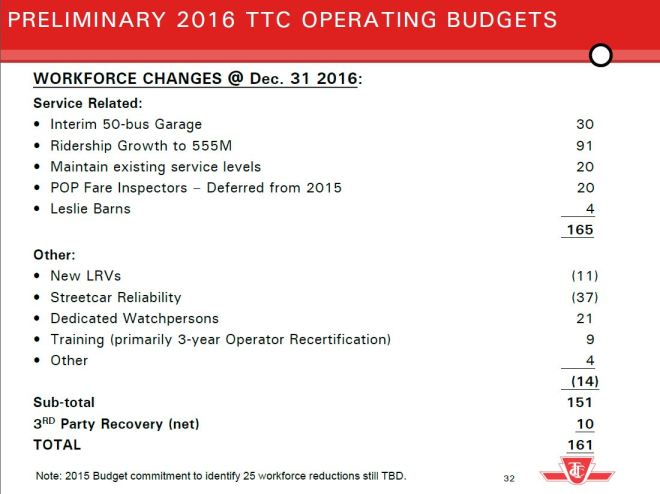
Of particular note here is that the TTC expects to staff Leslie Barns primarily through redeployment of staff rather than by duplication. Too, reliability from the transition to new streetcars and from improvements on the older fleet that remains is expected to reduce costs by $48m.
For some members of Council, "headcount" is a fetish which pre-empts whatever other word. In the case of many urban center services, the argument is always about doing more with less, merely that'south not an pick if you want to operate and maintain a larger fleet for longer hours and for more riders. The discussion needs to exist much more intelligent and begin from the viewpoint of what service is to exist provided, and so how tin this all-time be done, not simply a blanket objection to hiring more than staff.
Future budget pressures are listed in the presentation, but with no estimated values for events such equally:
- Opening of the Spadina extension in late 2017
- Full Presto rollout
- Boosted construction effects from major projects
- Energy costs
- AODA implications (run across WheelTrans budget below)
- Inefficiencies from crowded omnibus maintenance facilities
- Any new fare policy (a proposal volition go to Council later this year)
- A new Commonage Understanding in 2018
One of the recommendations in Quango'south approving of the 2015 budget was a request for the TTC do develop multi-year budget plans to deal with items such as these, only there is as all the same no data on what 2017 and beyond will look similar.
The WheelTrans Budget reflects a strong demand for more service.
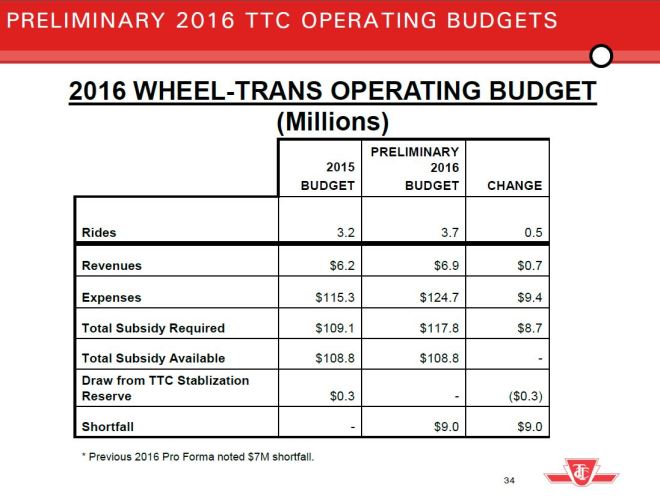
This reflects the fact that ridership is growing at 13.seven%, well-nigh double its historical rate, and that there is an AODA requirement that the "unaccommodated rate", the proportion of requests for service that cannot be provided, average 0.v%. Unlike regular service, AODA mandates provision of rides for almost all who are entitled to and want them.
Almost all of the increase is accounted for by the service needed to handle more than riders. This is even so another $nine million that Council must fund, and more than generally they must face the fact that this requirement volition continue to grow in future years. There is no funding from Queen's Park for this service, and all of the cost falls on Toronto.
Source: https://stevemunro.ca/2015/07/28/preliminary-ttc-2016-operating-budget/
0 Response to "Again Refer to Carroll Clinics 2016 Operating Budget"
Postar um comentário